Universal (2023) 111 min. R
Director: David Gordon Green
Screenplay: David Gordon Green & Peter Sattler; Story: David Gordon Green, Danny McBride & Scott Teems
Cinematography: Michael Simmonds; Editing: Tim Alverson
Production Design: Brandon Tonner-Connolly; Set Decorator: Shane Vieau; Costumes: Barbara Vazquez & Lizz Wolf; Score: Amman Abbasi & David Wingo
Stars: Leslie Odom Jr. (Victor Fielding), Lidya Jewett (Angela Fielding), Olivia O‘Neill (Katherine), Jennifer Nettles (Miranda), Norbert Leo Butz (Tony), Ann Dowd (Ann), Ellen Burstyn (Chris MacNeil), Okwui Okpokwasili (Dr. Beehibe), Raphael Sbarge (Don Revans), Danny McCarthy (Stuart), E.J. Bonilla (Father Maddox), Tracey Graves (Sorenne Fielding), Lize Johnsston (Lamashtu), Linda Blair (Regan MacNeil)
I’m not sure what it says about me, but The Exorcist was one of the formative films in my moviegoing experience. It became one of the ones that piqued my interest in movies as an artform. And when movies mean that much to you when you’re young and impressionable, it’s difficult to articulate the full shrieking horror of seeing what claptrap modern Hollywood makes of those giants upon whose shoulders it stands. Maybe Star Wars fanboys, or those of DC comics, would understand best. It tends to overwrite our memories of the original, jumbling them all together with the latest version, and tarnishing what we cherished about it in the first place. Believer doesn’t start out bad, but like most horror movies today, it keeps getting worse and worse as it goes along. So, by the end, when we should be feeling most fuzzy and nostalgic toward it, we have little generosity or good will left to expend. Our patience has been exhausted. This Exorcist is a small, shivering shadow of its former self. And hence, it offers depressingly little for a review to chew over.It’s a slow burn, perhaps in homage to the well-paced buildup of the original. But what the first movie had us wait so long for justified the suspense. This one just delivers what we expected was coming all along, without any surprises. Believer proves itself to be just another undistinguished entry in what has become by this point, indistinguishable from any other horror movie franchise. The original Exorcist helped to change the reputation of horror forever, forcing the genre to be taken seriously for the first time by the mainstream. Believer, on the other hand, fails to exceed expectations. Even the anticipation generated by the much-ballyhooed return of Ellen Burstyn to her iconic role of Chris MacNeil. She gave an impassioned, critically acclaimed performance in the relatively recent Pieces of a Woman, and it’s always a pleasure to see her whenever she pops up onscreen, which is far too rarely these days.
But it’s not clear why this highly regarded actress chose Believer to finally lend her cachet to, out of all the exorcist movies that have come down the pike in the years since the first one. It doesn’t stand out too terribly much from the cottage industry of sub-exorcist films the original continues to inspire down to this day. Perhaps Burstyn is simply at that time of life when she’s gained proper perspective on her career. Rather than waiting for something more prestigious to come along to hang her laurels on, she’s come to terms with the fact that The Exorcist is the big one for which she’ll always be remembered. The actress appears to have reached that stage where she’s willing to bestow her endorsement on all the Comic-Con level silliness once regarded as beneath her. Privileging us with the ethereal sight of a living legend again gracing a timeless classic with her presence. To be kind, there have been more unbecoming swan songs in cinema history.But damn the dunderheaded enterprise that doesn’t even know how to use its legacy characters effectively when they do deign to return after all this time. As an actress, Burstyn has become wizened by accolade over the years. And though she’s now befittingly silver, her Chris doesn’t appear to have changed her hairstyle much since the 70s, so it’s easy to allow oneself be blasted back to the past. There’s one moment, with Burstyn touring a haunted house, where I felt like the filmmakers were attempting to turn the character into a latter-day Lorraine Warren. But ultimately, she seems to have been shoehorned into proceedings. The actress’ scenes are so disconnected from everything else, she might have crossed over from another movie entirely, though her original Exorcist was the specific catalyst for everything that transpires in this one.
She’s just plopped right down into the thick of things, without giving us a chance to reflect on why the franchise has never bothered checking in with her before now, or give us the leisure to reacquaint ourselves, catching up on what’s she’s been doing over the past half century or so, apart from a cursory sketch. After all these years we feel we’d like a bit more time to catch up. I’d hate to think Burstyn’s appearance was orchestrated simply for the sake of fan service. Though I guess she gets off easier here than her Chris did in the TV series with Geena Davis. Still, the lack of respect accorded to legacy characters in these franchises, built on the backs of their innovation and hard work, is disheartening.
The choicest bits of what seem to have been intended for her part have instead been sublimated into character actress Ann Dowd, who plays with a sincerity and earnestness this movie doesn’t really warrant, just to remind us what a good actress cinema is wasting. She possesses great elocution, and her lower chest tones seem to boom out of her when reading from the liturgical cannon, reverberating off the flying buttresses and vaulted ceilings, like the echoes in a medieval Cathedral. Any demon would be stopped dead in its tracks to be put on blast this way.Dowd has even been given scenes intended to recall her acclaimed performance in Mass, such as when sitting at that long wooden table at the police station, pondering over the nature of good and evil in a way that recalls Max von Sydow and Jason Miller’s discussion in that deleted scene on the stairs in the original. But given Dowd’s monologue here serves no real narrative purpose either, aside from self-consciously stopping the movie cold, it might have been better to delete it as well.
It seems supremely odd when the film suddenly anoints her Ann with the authority to cast out demons, when the Burstyn character, with her lay training, seemed to be being set up as the new title character earlier on. It’s a role she’s seemed destined to step into since the ‘70s, conferred with the power to compel us after a half century of screen legacy. But the more Dowd is in the movie, the less Burstyn is. The shifting of focus was apparently necessitated by COVID health concerns for the elderly actress, which had Burstyn’s scenes shot separately back in 2021, extremely scaling back her screen time.
But then, if I were a prestigious Oscar-winning actress, I’d probably have wanted to be distanced from the final product as well. At one point director David Gordon Green allows her to go on and on without a cut, giving an important speech about bringing people together as a community, and the lack of verbal rhythm, with hardly a breath between words, does the disservice of making her sound as if she were rambling on incoherently. It’s really inexcusable after Green guided Jamie Lee Curtis so expertly through Halloween Ends. He’s being conferred by the film industry with the authority to lay to rest all kinds of sacred screen gods and monsters these days. It’s more power than one man merits.
Burstyn’s scenes appear to have been originally shaped to some purpose, with the intention to feature her at the center of the action throughout. And the cutting during the exorcism, which keeps jumping back to her own heart monitor by the hospital bed, suggests she’s meant to play a more direct role in the final conflict, perhaps sacrificing her life to save the possessed girl, as Karras did in the original. Like Gordon’s Halloween series which just wrapped, Believer was planned as the first entry in a trilogy of new Exorcist films to be helmed by him, with the second installment, Deceiver, scheduled for 2025 release. The outlines for the follow-up films have already been sketched out.So, there may be much which makes no sense in Believer’s muddled scenario, that was simply intended to lay the groundwork for future payoffs. But the uncertainty fails to do this first film any favors. (Its shaky performance at the box office has also put the fear of God in the filmmakers, with talk now about taking the future films in a different direction.). Nothing comes of the scenario’s suggestion that the Chris character needs to ‘open her eyes’ to find her lost daughter, for instance. On the face of it, her unnecessary scourging ends up having little whatever to do with the rest of the film, so there’s no point trying to puzzle out its purpose. We’d need a God’s-eye-view.
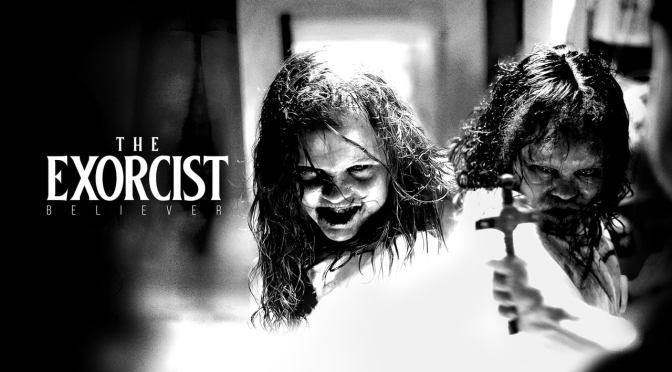
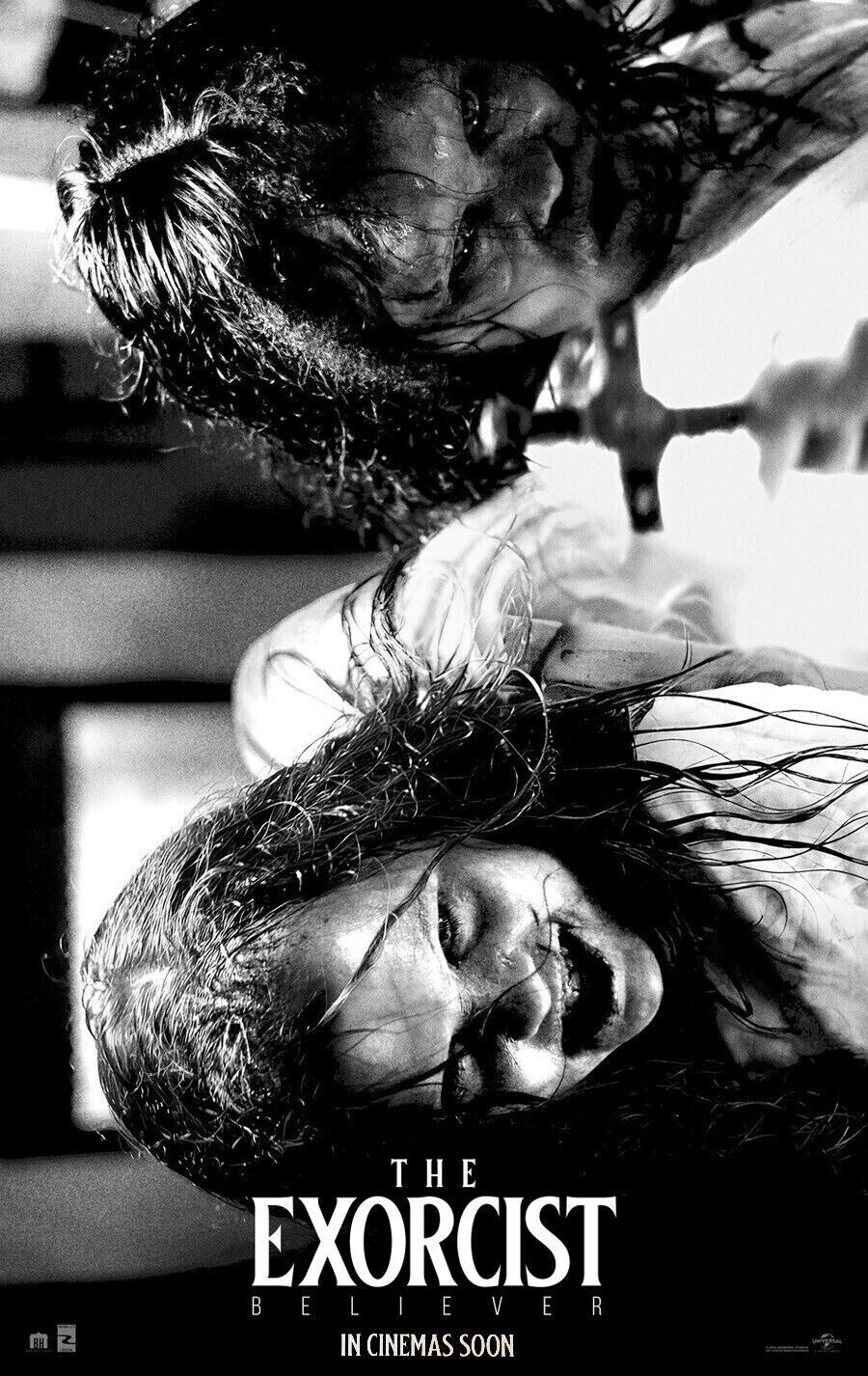
Olivia O‘Neill, who plays one of the afflicted girls, Katherine, seems to have been specifically cast due to her strong resemblance to a little Linda Blair. And through shrewd framing, makeup and shadowy low-lighting, the movie tries to blur our memories of the original Exorcist with the similar visuals in this one. But her big confrontation with Burstyn has, inexplicably, been plunked right down in the middle of the movie, like the chariot race in Ben-Hur, after which the drama continues limping on for another hour or so afterward. With so much of Green’s insidious imagery intended to evoke the earlier film, when Katherine giddily reaches for that familiar, shiny little crucifix to start violently jabbing away again, we’re given pause. Because suddenly we realize how much movies have changed since the graphically realistic era of the early ‘70s that the original Exorcist emerged out of. And how chastely circumspect today’s slickly polished, airbrushed variations on the theme have become by comparison.Rather than daring to hold itself up as a sequel worthy of being whispered in the same breath as the original, Believer is a truly astonishing case study in carefully inoffensiveness moviemaking. Though it never reaches the enjoyably ludicrous heights of, say, The Pope’s Exorcist, which tried to make its possessed little boy sound lewd and appear intimidating, though he couldn’t have amounted to more than 50 pounds soaking wet, Believer still makes it perfectly clear why none of these exorcism movies have ever really worked since the original.
The 1973 Exorcist was directed by William Friedkin, who just died this past summer and was, at the time, still sizzling hot off his Oscar-winning Best Picture, The French Connection, which had been shot in a strikingly realistic, docudrama style intended to blur the line between fact and fiction. Friedkin, who came from a background in documentaries, helped pioneer and popularize this new look of ‘70s American cinema. And it was specifically its quality of authenticity that made the original Exorcist seem so credible and powerful, what had people reportedly throwing up and fainting in the aisles. As commentators noted at the time, no other mainstream American movie had presented such graphic language and imagery to a widespread audience. Not even the X-rated Oscar winner Midnight Cowboy, a few years earlier.
No horror film had ever taken itself that dead seriously before. And most viewers weren’t prepared for the harsh realism of such an explicit presentation, which seemed to hold nothing back. How far it went was considered truly shocking for the time. But alas, times have changed. Director Green never attempts to use the tools of his trade to convince us, stylistically speaking, that what we’re seeing is real. Instead, he’s had cinematographer Michael Simmonds shoot the movie in a glibly professional manner, in order to make it look like any other entry in The Conjuring franchise.Even if adult doubles were used for the more explicit moments, the dubious casting of underage actresses like Linda Blair, Brooke Shields and Jodi Foster in rather prurient roles during the ‘70s might seem more suspect today, when no big, or even moderately, budgeted movie would dare chance the accusation of child exploitation, for fear of the backlash and negative impact on the box-office. But it’s surprising that none of these exorcist movies appear to have realized that this very fear is what defangs their subject now – their hand wringing, knee-knocking the only evidence of Satanic panic onscreen or off. What was so frightening about the original was watching, in slowly escalating, graphically realistic detail, a child morphing into a demonic monster before our eyes – tapping into every parent’s greatest fear of their sweet and innocent little angels rapid-aging into sexually promiscuous, foul-mouthed teens. Watching demon-ravaged Regan’s trussed up body tied down in the station of the cross, while being scourged and desecrated in ways purposely meant to imply violent sexual assault, left us feeling as helpless as her mother, as we listened to her screams. But there’s no way movies would dare try to approximate that now, without leaving viewers so uncomfortable they became queasy, in a way the original movie didn’t mind making them. The last thing in the world an unapologetic cash grab like Believer wants is to make its intended audiences uncomfortable. It’s far more terrified of that than the legions of demons it trots out for show.Here, the isolated attempts to make the girls seem unnaturally salacious are so tepid it’s just embarrassing. And there’s no actress the caliber of Mercedes McCambridge to cover over the patches by providing the more demanding vocal effects (the demon voices are rendered here by Helen Leahey, Christopher Allen Nelson and J. Moliere). At times, the harshly guttural demon even affects a hilarious, hoity-toity British accent to imitate Burke Dennings, whose character is never referenced in this film, not even to address the long-standing question about what he was doing up in Regan’s room in the first place.Believer is perhaps at its best or, at least, its most harrowing early on, when the girls have just gone missing. The police procedural aspects are unsettling because they remind us of so many real-world, true crime cases in which milk carton kids are never found. Also fascinating is the fallout on the two sets of parents as they simultaneously bond with one another, as the only people who can understand what they’re going through, being in the same situation themselves, and turn against each another, assigning blame for what happened to the only convenient target in their line of sight, with no perp having yet been identified. This part is at least on par with Denis Villeneuve’s expert Prisoners. But since we know there can be no exorcism if the girls don’t return, there’s no real suspense in this section, since there’s no doubt about the outcome.And when they are found they’re conveniently amnesiac, Picnic at Hanging Rock-style. So, we never learn exactly what happened to them out there, leaving the mystery, which should be cut and dried, unsolved. Why did that apparent invocation they performed, so the bereft Angela (played by Lidya Jewett) could contact her dead mother (played by Tracey Graves), set them aimlessly wandering through the woods for three days? This element doesn’t match up with anything else ever defined in the exorcism cannon. It seems to have been borrowed from Missing 411 mythos. And since the sound was so muffled by the rain, I wasn’t sure what the carcass of that mutilated horse was supposed to signify. I’m assuming their disappearance wasn’t meant to be linked to alien abduction.
The only unique vantage evident in Believer, unfortunately, is the shifting of races, so that the overly familiar events are now presented from the point of view of black characters. But the way things play out, they bring no new shadings to proceedings, as we’re led to believe they might, early on, with that intriguing prologue set in Haiti. There was some purpose to having the original movie open in Iraq, in the midst of an archeological dig. But our demon here doesn’t turn out to hail from any specific region of the world, though it might have been more interesting if it had.
The black roles might as well have been written for white characters to play. They’re as racially indistinct as the representative religions. And when the parents start panicking over the missing girls and tempers explode, things don’t reach a racist level of insults and antagonisms, the way lived experience tells us they would, given society’s current culture war tensions. At the very least, the racial disparity of the two victims here should have prompted the movie to point up the prominence corporate media typically places on missing white girls, as opposed to those of other races.But as the search wraps up, the script never sprinkles in any tell-tale signs that should have been adding up in this regard. Instead, it waits all the way until the very end, during the exorcism finale, to point up the greater stress placed by our society on ensuring the safety of white lives, as opposed to those of black ones. We get to know little of daughter Angela before she’s possessed, so we don’t really have time to emotionally invest ourselves in the character to the degree we should. Consequently, we can’t work up the requisite emotion demanded for her, as an individual, when she’s meant to be suffering.
We only feel pity for her the same way we would any other stranger we’d ambiently heard about in the news. The other possessed girl comes off even worse, she’s treated like an afterthought. As Angela’s father, Victor Fielding, Hamilton legend Leslie Odom Jr., who was so good as Sam Cooke in One Night in Miami, brings a blessed stillness to his role, which helps to anchor the drama. He remains the becalmed center of the storm when everything around him starts swirling into melodramatic overdrive. So, Odom is never lowered to the movie’s own level.In the fifty years since the original Exorcist, Linda Blair has been supplanted in the mind by so many lookalikes and imitators (perhaps most successfully Samara from The Ring), we’ve developed almost a fondness for the character, the way we do when watching old Frankenstein or Wolfman films. So, when young actresses are required to imitate the real deal, as both young victims are here, it seems almost sacrilegious. Perhaps that’s why they doubled the effect, diabolism times deux, thinking two Blairs would be more persuasive than one. When they’re both seated back-to-back, and their heads snap around and sort of entwine into one another, like a snake pit from the overhead shot, they form a yin and yang pattern. Though the movie never bothers parsing out the meaning of this reoccurring twinning motif, we see the men carrying a large mirror out of the house prior to the exorcism.There’s definitely a doubling effect in evidence here, with repeated reference to babies being ripped from their mothers’ wombs, with Ann having had an abortion and Angela being born premature when her dying mother was injured in an earthquake. But when we’re told only one of the girls can survive, cleaving them in two, we wonder why everyone involved is immediately okay with letting the devil determine those odds. But by that point in proceedings, we know better than to expect that scriptwriters Green and Peter Sattler (from a story by Green, Danny McBride & Scott Teems) will come up with anything clever and original, since they’ve long since fallen lazily back on the tried and true. Instead of the wisdom of Solomon, we get a ham-handed Sophie’s Choice, without much sense made of the why and how come, or how it interrelates with that original choice Victor had to make between saving his wife or saving his daughter.And for some reason the women are made to suffer for the selfishness of Katherine’s father (played by Norbert Leo Butz), whose behavior condemns them all. And if the devil can cavalierly pop up at this party uninvited, it seems a bit cruel that the mother Angela was reaching out to in the first place, never does. Not even to protect her baby girl, as Lin Shaye’s did in The Last Key. Plot armor ensures we know who will survive these uneven odds, but the question is why the immortal soul of the other little girl, through no fault of her own, is treated so cruelly (it’s like the film were working out some lingering ill will over what she did to Chris). As he did with Michael Myers in Halloween Ends earlier in the year, Green has deemed himself the one director in modern cinema worthy of laying all the endless Regan imitators permanently to rest.
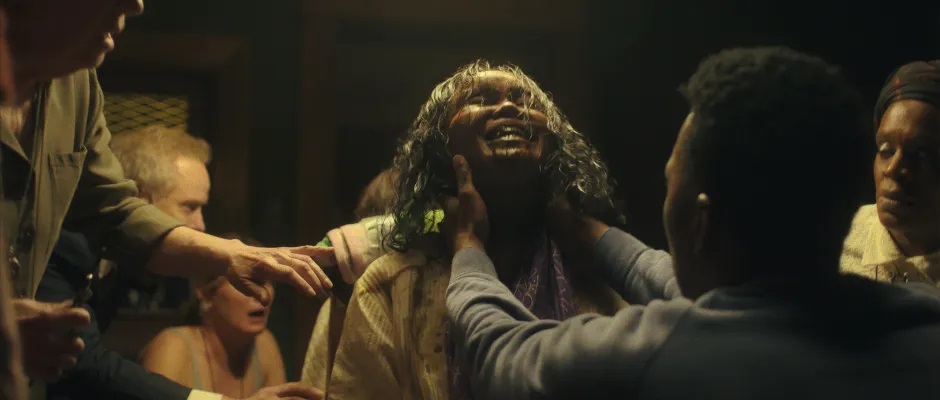
As a subgenre, exorcism movies all bespeak a woeful lack of imagination on the part of their makers, and Believer is no different. Invariably they follow the exact same shtick, in which a child (when feeling really racy they’ll make it a little boy, as in the original case study that inspired William Peter Blatty’s book), becomes possessed, bedridden and must be cured, usually through some form of Christian Science. What’s funny, and ultimately inexplicable, about Believer is that Catholicism is no longer depicted as the One True religion capable of casting out demons, as it is in most other exorcism and Nun movies, right back to the original. Chris repeatedly claims, based on her globetrotting travels that all cultures and faiths have their own forms of exorcism. And her big speech about coming together is the catalyst intended to unite the warring religious factions which have all been separately trying to exorcise the girls’ demons to prove the superiority of their faiths. It sets the proper mood to allow them to finally pool their individual strengths, doing together what they’d each failed to do alone. It’s purposely not stressed what precise denomination each is representing, since they’re meant to be more representative of familiar, if unspecified, religions. Each has deliberately been made to seem generic, so they can stand in for all denominations. It’s a very Unitarian Universalist approach, though we don’t see any sample, say, Muslims or Buddhists in attendance. The Pentecostal religion the neighbor Stuart (played by Danny McCarthy) is part of seems more holistic than evangelical (there’s also a gym scene inserted that suggests he’s Victor’s boxing manager, which is apropos of nothing else in the movie). While rootwork healer Dr. Beehibe – her real name in the film (played by Okwui Okpokwasili) – incorporates elements of shamanism and voodoo. Katherine’s parents attend a standard issue Baptist church presided over by Pastor Don Revans (played by Raphael Sbarge) that might be mistaken for any other protestant denomination. It appears to be sandwiched somewhere between midtown and megachurch. Ann is a relapsed Catholic. While Victor is meant to stand in for the agnostic Chris character from the original movie, whose traumatic experience brought her closer to God. But despite all the indeterminate and nondenominational faiths amassed to fight the demon at the end of Believer, it’s still only the appearance of the Catholic priest (played by E.J. Bonilla) that imparts the impression of having any appreciable command. But then he’s dispatched peremptorily in a way that seems mockingly intended to scream couldn’t-forget-our-signature-move. And after twisting his head like a cap off a bottle, he’s promptly forgotten about by the script. Despite Katherine’s mother Miranda (played by Jennifer Nettles) having declared that Christ descended to Hell in the three days prior to his resurrection to declare his dominion over Satan, it’s the devil who ultimately gets his due here.The original movie sent scores of viewers who had lost their religion scuttling back either to God or into therapy. But none of the various faiths that take a turn on Believer’s carousel appear to have any effect, so there’s no real feel for established religion, or any other, apparent here. Despite its title, Believer puts no real stock in anything much, leaving those of us who might have wanted to believe in something feeling bereft and abandoned, like there’s no comforting religion with any power for good in the world left to believe in. And if the film leaves us with nothing to believe in except for talismans and our own resourcefulness, who then, pray tell, is supposed to be the true Believer?
The only thing that seems certain is how the moviemakers expose themselves as philistines at work, money changers in the temple whose only faith is in the box-office, their great golden calf, their only prayers being sent up for an impressive opening weekend haul. Religion is just used as background filler for a silly Hollywood spook show, like those seasonal Hell houses that churches set up around Halloween, with the intention of scaring kids straight. At the end, Green remains as agnostic as parents Victor and Chris were, at the outset. Victor, and to a lesser degree Ann, are the only people involved in the exorcism whose supernatural experiences are intended to restore their faith, like Karras in the original. And I’m sure even afterward they’d both describe themselves as ‘spiritual’ rather that devout.The original Exorcist was a deeply conservative film that showed an America on the verge of collapse. The country seemed splintering apart in the era of Vietnam, Watergate, and in the wake of all the political and social unrest of the ‘60s. The type of world situation religious pundits have always warned us signals the End of Days and coming Armageddon, during which the devil will be unchained to stalk the earth for a thousand years (according to your own given denomination). Believer likewise wants to draw a direct parallel between that time and this, with our own widening culture wars and political schisms reaching a boiling point, unseen in this country since the early ‘70s.
Burstyn’s big speech about bringing people together seems intended to speak directly to the increasing sense of isolation that has cropped up, especially since COVID distancing measures were put in place, contributing to that growing gulf and chipping away at our sense of shared community, friendships, family, churches, schools, all the institutions and bulwarks of society that traditionally helped people socialize, stay connected, and find common ground, making them feel close to their neighbors, invested in their communities and committed to taking part in their civic duties. But Believer fails to fully clarify even the most basic, invisible details. When the Fielding’s neighbor across the way initially appears, complaining about the garbage cans left on the street, it’s not until later that we realize it was actually Ann. Not only does she live right next door, but she’s also a nurse at the hospital Angela is taken to as well. Why is it made to seem like the daughters purposely kept the fact that they were friends away from their parents, when Katherine was seen greeting Victor when he dropped Angela off at school? And when a point is made that vegan Angela no longer eats meat, discarding the sausage that her father serves for breakfast, we have every right, when she returns, to expect her to ask where’s the beef, just to mark the change in her character. But she never does.When her bathtub mysteriously fills with muddy water, and Angela suddenly goes missing again, we sit there dumbfounded as to why her father doesn’t do the obvious thing anyone else would, and stick his hand beneath the surface to see if she’s drowned in there, before he starts searching the house for her. One could construe that the Victor Fielding character was named for Victor Frankenstein, but you’d have to consult a crystal ball to figure out what was intended by that. The movie doesn’t attempt to make any correlation between his job as a photographer and Chris’ lack of sight. It never even makes it clear precisely who this demon is supposed to be. We must assume it’s not Pazuzu. And at the end of the exorcism, we wonder, given the amassed death tally, if these laypeople have ever heard of Anneliese Michel, whose tragic demise the popularity of the original Exorcist probably had more than its fair share to do with.
Believer is as much an homage to the original as a direct sequel to it. It keeps trying to hit the same major beats, without providing any of the necessary context. At the same time, the movie doesn’t mind pulling in elements, even jump scares, from just about all over, dipping in and out of a hodgepodge of other horror films released over the intervening years. Early on, widower Victor sees that the portraits he’s taken of the ‘perfect’ nuclear family, have been warped. But since nothing further comes of this, we’re left to assume the movie must have gotten its wires crossed with The Ring for some unfathomable reason. There’s the shock shot of the demon standing directly behind the father, whose framed precisely like Patrick Wilson was, when that red Lipstick-Face Demon first appeared behind him in Insidious.
There’s the expulsion of ectoplasm from the mouth, which just kind of roils and twines like a constrictor, as we’d seen in The Haunting in Connecticut and a host of other movies. This gambit has become such a given, it even upstages the classic pea soup bit, when that’s dredged back up. Even Drag Me to Hell is referenced by the end. The Exorcist was better than this. The Exorcist preceded all this, with few cinematic precedents of its own to draw upon for inspiration at the time. It’s the law of diminishing returns. Why can’t the movies ever let a good horror film rest in peace?The problem with Believer, like all the other reboots and franchises and sequels it’s sharing screen space with this spooky season, is that it exerts a major mind warp on our sensibilities. Movies like this exist within their own hermetically sealed universe, one that operates according to its own internal logic. It’s a world where cultural phenomenon like The Exorcist (and the offspring it’s inspired, such as The Exorcism of Emily, The Final Exorcism, and The Pope’s Exorcist) never existed. But where the paranormal lore and logic that Exorcist movies have established over the years, all the ‘laws’ that govern the genre, are quite real and still hold sway.
The suspension of disbelief these movies require can become quite maddening, even if one rarely questions it in the moment. When the girls first begin dabbling with Ouija boards, for example, opening themselves up to demonic forces, our first thought, naturally, is ‘haven’t you seen The Exorcist?’ It’s a chancy proposition at this late stage in the day to return to your primary sources when we’ve had fifty ceaseless years of parodies, imitations and more philosophical and better made follow-ups to sift through these same circumstances.The original Exorcist tried to be many things – a Medieval miracle or mystery play, a Gothic haunted house chiller, a detective story – but, above all, it was a very Ingmar Bergmanesque treatise on the eternal battle between the sacred and profane. Which explained the casting of Max von Sydow, again squaring off with death, as he had in The Seventh Seal. But all these deep thoughts seem to have bled out over the years. Exorcism seems to have lost its punch in an increasingly secular world where garden variety acts of depravity and evil surpass anything the most creative demon could ever dream up.
Does the world really need a horned, cloven-hooved devil stomping about in the flesh; it’d seem like amateur hour compared to your everyday serial killer or political demagogue. This latest Exorcist entry is just a cheesy horror show, with delusions of being something more august, due to the esteemed company it’s keeping – horror movie royalty. But at least it’s coming out at just the right time for a scary, seasonal Halloween sugar rush, rather than the day after Christmas, like the original did.

 Universal (2023) 111 min. R
Director: David Gordon Green
Screenplay: David Gordon Green & Peter Sattler; Story: David Gordon Green, Danny McBride & Scott Teems
Cinematography: Michael Simmonds; Editing: Tim Alverson
Production Design: Brandon Tonner-Connolly; Set Decorator: Shane Vieau; Costumes: Barbara Vazquez & Lizz Wolf; Score: Amman Abbasi & David Wingo
Stars: Leslie Odom Jr. (Victor Fielding), Lidya Jewett (Angela Fielding), Olivia O‘Neill (Katherine), Jennifer Nettles (Miranda), Norbert Leo Butz (Tony), Ann Dowd (Ann), Ellen Burstyn (Chris MacNeil), Okwui Okpokwasili (Dr. Beehibe), Raphael Sbarge (Don Revans), Danny McCarthy (Stuart), E.J. Bonilla (Father Maddox), Tracey Graves (Sorenne Fielding), Lize Johnsston (Lamashtu), Linda Blair (Regan MacNeil)
Universal (2023) 111 min. R
Director: David Gordon Green
Screenplay: David Gordon Green & Peter Sattler; Story: David Gordon Green, Danny McBride & Scott Teems
Cinematography: Michael Simmonds; Editing: Tim Alverson
Production Design: Brandon Tonner-Connolly; Set Decorator: Shane Vieau; Costumes: Barbara Vazquez & Lizz Wolf; Score: Amman Abbasi & David Wingo
Stars: Leslie Odom Jr. (Victor Fielding), Lidya Jewett (Angela Fielding), Olivia O‘Neill (Katherine), Jennifer Nettles (Miranda), Norbert Leo Butz (Tony), Ann Dowd (Ann), Ellen Burstyn (Chris MacNeil), Okwui Okpokwasili (Dr. Beehibe), Raphael Sbarge (Don Revans), Danny McCarthy (Stuart), E.J. Bonilla (Father Maddox), Tracey Graves (Sorenne Fielding), Lize Johnsston (Lamashtu), Linda Blair (Regan MacNeil)
 I’m not sure what it says about me, but The Exorcist was one of the formative films in my moviegoing experience. It became one of the ones that piqued my interest in movies as an artform. And when movies mean that much to you when you’re young and impressionable, it’s difficult to articulate the full shrieking horror of seeing what claptrap modern Hollywood makes of those giants upon whose shoulders it stands. Maybe Star Wars fanboys, or those of DC comics, would understand best. It tends to overwrite our memories of the original, jumbling them all together with the latest version, and tarnishing what we cherished about it in the first place. Believer doesn’t start out bad, but like most horror movies today, it keeps getting worse and worse as it goes along. So, by the end, when we should be feeling most fuzzy and nostalgic toward it, we have little generosity or good will left to expend. Our patience has been exhausted. This Exorcist is a small, shivering shadow of its former self. And hence, it offers depressingly little for a review to chew over.
 It’s a slow burn, perhaps in homage to the well-paced buildup of the original. But what the first movie had us wait so long for justified the suspense. This one just delivers what we expected was coming all along, without any surprises. Believer proves itself to be just another undistinguished entry in what has become by this point, indistinguishable from any other horror movie franchise. The original Exorcist helped to change the reputation of horror forever, forcing the genre to be taken seriously for the first time by the mainstream. Believer, on the other hand, fails to exceed expectations. Even the anticipation generated by the much-ballyhooed return of Ellen Burstyn to her iconic role of Chris MacNeil. She gave an impassioned, critically acclaimed performance in the relatively recent Pieces of a Woman, and it’s always a pleasure to see her whenever she pops up onscreen, which is far too rarely these days.
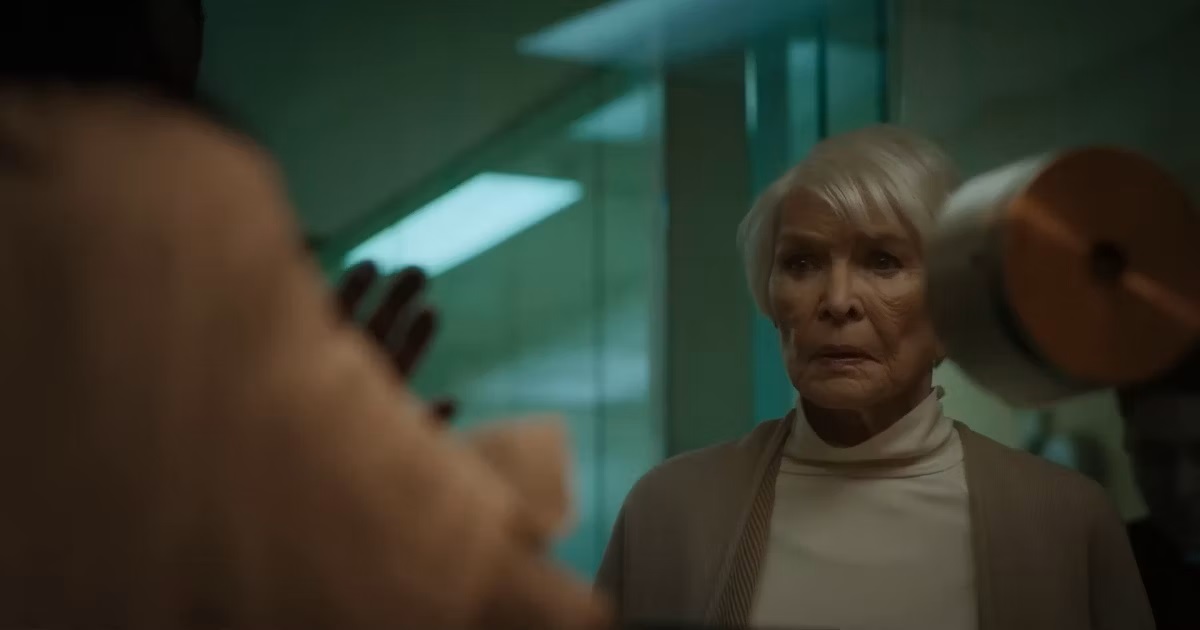 But it’s not clear why this highly regarded actress chose Believer to finally lend her cachet to, out of all the exorcist movies that have come down the pike in the years since the first one. It doesn’t stand out too terribly much from the cottage industry of sub-exorcist films the original continues to inspire down to this day. Perhaps Burstyn is simply at that time of life when she’s gained proper perspective on her career. Rather than waiting for something more prestigious to come along to hang her laurels on, she’s come to terms with the fact that The Exorcist is the big one for which she’ll always be remembered. The actress appears to have reached that stage where she’s willing to bestow her endorsement on all the Comic-Con level silliness once regarded as beneath her. Privileging us with the ethereal sight of a living legend again gracing a timeless classic with her presence. To be kind, there have been more unbecoming swan songs in cinema history.
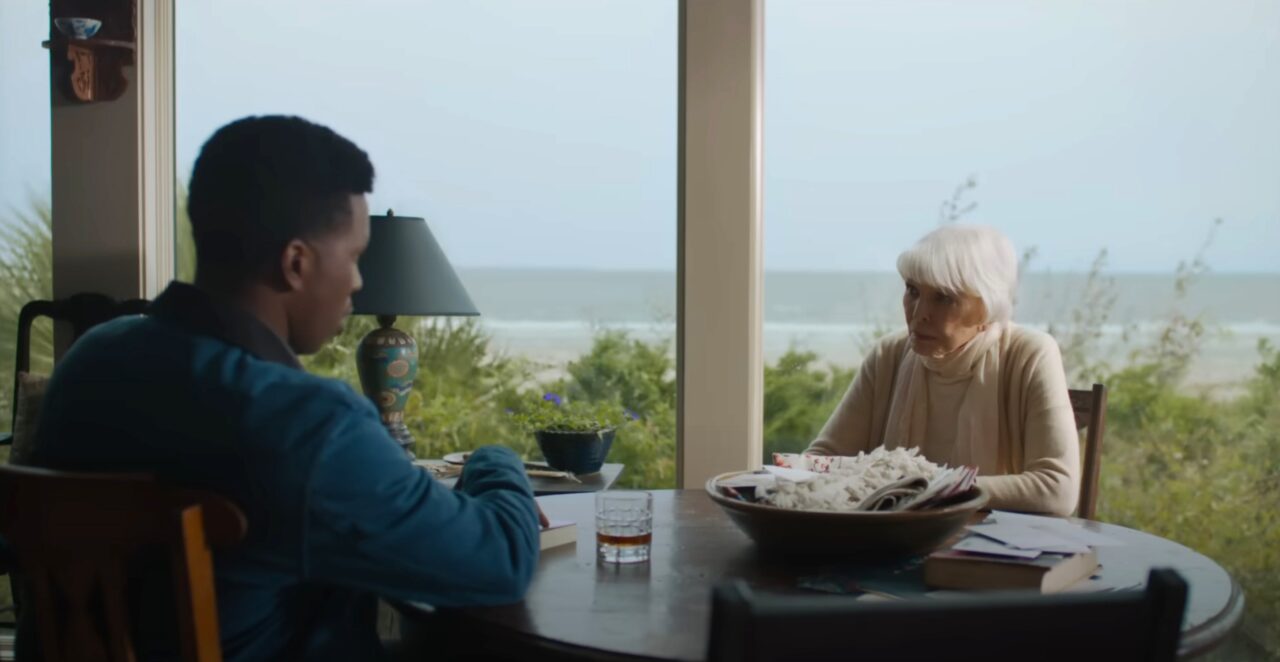 But damn the dunderheaded enterprise that doesn’t even know how to use its legacy characters effectively when they do deign to return after all this time. As an actress, Burstyn has become wizened by accolade over the years. And though she’s now befittingly silver, her Chris doesn’t appear to have changed her hairstyle much since the 70s, so it’s easy to allow oneself be blasted back to the past. There’s one moment, with Burstyn touring a haunted house, where I felt like the filmmakers were attempting to turn the character into a latter-day Lorraine Warren. But ultimately, she seems to have been shoehorned into proceedings. The actress’ scenes are so disconnected from everything else, she might have crossed over from another movie entirely, though her original Exorcist was the specific catalyst for everything that transpires in this one.
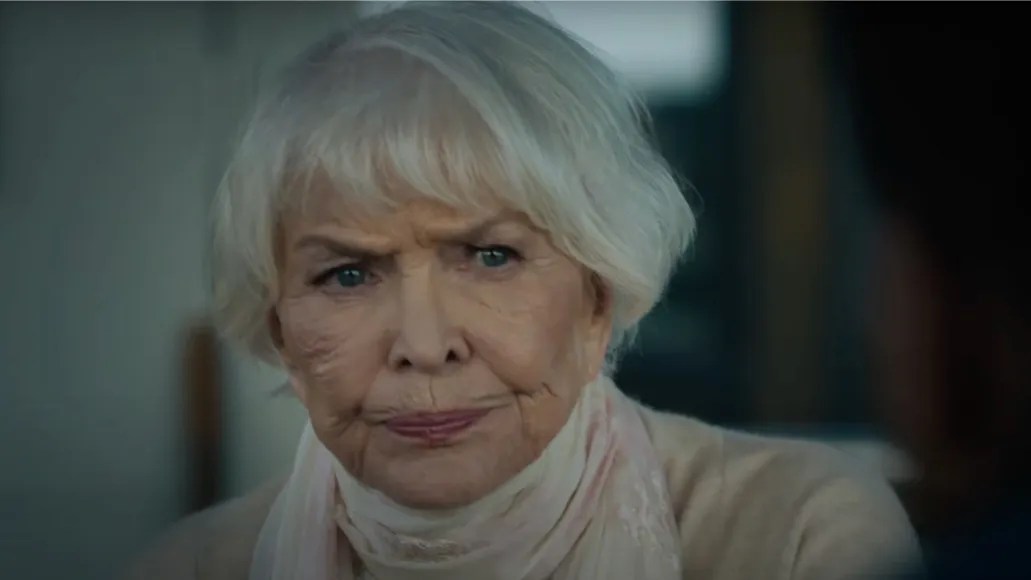 She’s just plopped right down into the thick of things, without giving us a chance to reflect on why the franchise has never bothered checking in with her before now, or give us the leisure to reacquaint ourselves, catching up on what’s she’s been doing over the past half century or so, apart from a cursory sketch. After all these years we feel we’d like a bit more time to catch up. I’d hate to think Burstyn’s appearance was orchestrated simply for the sake of fan service. Though I guess she gets off easier here than her Chris did in the TV series with Geena Davis. Still, the lack of respect accorded to legacy characters in these franchises, built on the backs of their innovation and hard work, is disheartening.
The choicest bits of what seem to have been intended for her part have instead been sublimated into character actress Ann Dowd, who plays with a sincerity and earnestness this movie doesn’t really warrant, just to remind us what a good actress cinema is wasting. She possesses great elocution, and her lower chest tones seem to boom out of her when reading from the liturgical cannon, reverberating off the flying buttresses and vaulted ceilings, like the echoes in a medieval Cathedral. Any demon would be stopped dead in its tracks to be put on blast this way.
She’s just plopped right down into the thick of things, without giving us a chance to reflect on why the franchise has never bothered checking in with her before now, or give us the leisure to reacquaint ourselves, catching up on what’s she’s been doing over the past half century or so, apart from a cursory sketch. After all these years we feel we’d like a bit more time to catch up. I’d hate to think Burstyn’s appearance was orchestrated simply for the sake of fan service. Though I guess she gets off easier here than her Chris did in the TV series with Geena Davis. Still, the lack of respect accorded to legacy characters in these franchises, built on the backs of their innovation and hard work, is disheartening.
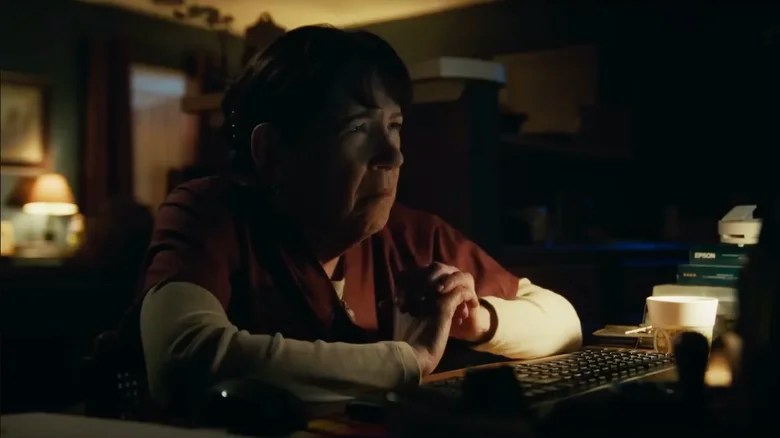
The choicest bits of what seem to have been intended for her part have instead been sublimated into character actress Ann Dowd, who plays with a sincerity and earnestness this movie doesn’t really warrant, just to remind us what a good actress cinema is wasting. She possesses great elocution, and her lower chest tones seem to boom out of her when reading from the liturgical cannon, reverberating off the flying buttresses and vaulted ceilings, like the echoes in a medieval Cathedral. Any demon would be stopped dead in its tracks to be put on blast this way.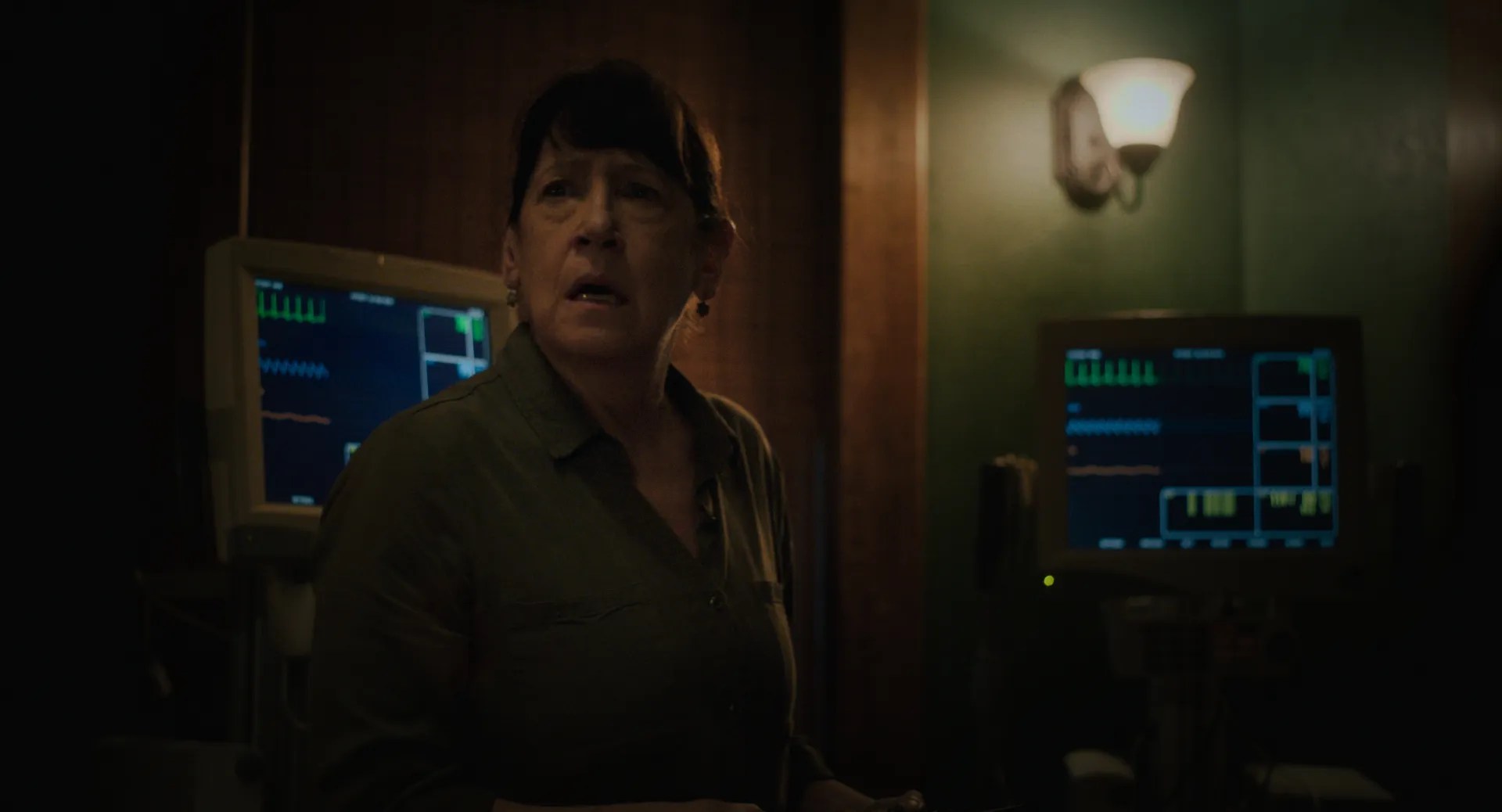 Dowd has even been given scenes intended to recall her acclaimed performance in Mass, such as when sitting at that long wooden table at the police station, pondering over the nature of good and evil in a way that recalls Max von Sydow and Jason Miller’s discussion in that deleted scene on the stairs in the original. But given Dowd’s monologue here serves no real narrative purpose either, aside from self-consciously stopping the movie cold, it might have been better to delete it as well.
It seems supremely odd when the film suddenly anoints her Ann with the authority to cast out demons, when the Burstyn character, with her lay training, seemed to be being set up as the new title character earlier on. It’s a role she’s seemed destined to step into since the ‘70s, conferred with the power to compel us after a half century of screen legacy. But the more Dowd is in the movie, the less Burstyn is. The shifting of focus was apparently necessitated by COVID health concerns for the elderly actress, which had Burstyn’s scenes shot separately back in 2021, extremely scaling back her screen time.
Dowd has even been given scenes intended to recall her acclaimed performance in Mass, such as when sitting at that long wooden table at the police station, pondering over the nature of good and evil in a way that recalls Max von Sydow and Jason Miller’s discussion in that deleted scene on the stairs in the original. But given Dowd’s monologue here serves no real narrative purpose either, aside from self-consciously stopping the movie cold, it might have been better to delete it as well.
It seems supremely odd when the film suddenly anoints her Ann with the authority to cast out demons, when the Burstyn character, with her lay training, seemed to be being set up as the new title character earlier on. It’s a role she’s seemed destined to step into since the ‘70s, conferred with the power to compel us after a half century of screen legacy. But the more Dowd is in the movie, the less Burstyn is. The shifting of focus was apparently necessitated by COVID health concerns for the elderly actress, which had Burstyn’s scenes shot separately back in 2021, extremely scaling back her screen time.
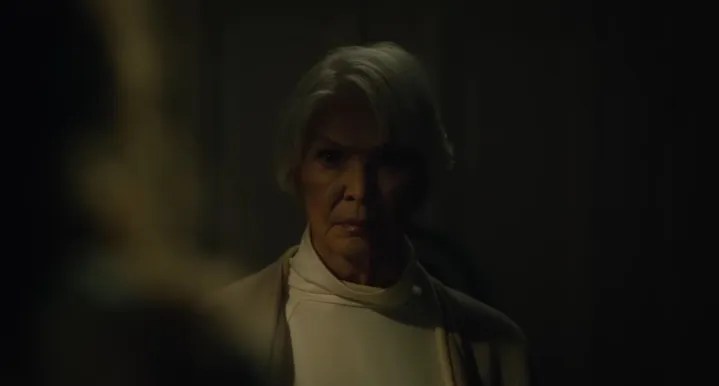 But then, if I were a prestigious Oscar-winning actress, I’d probably have wanted to be distanced from the final product as well. At one point director David Gordon Green allows her to go on and on without a cut, giving an important speech about bringing people together as a community, and the lack of verbal rhythm, with hardly a breath between words, does the disservice of making her sound as if she were rambling on incoherently. It’s really inexcusable after Green guided Jamie Lee Curtis so expertly through Halloween Ends. He’s being conferred by the film industry with the authority to lay to rest all kinds of sacred screen gods and monsters these days. It’s more power than one man merits.
Burstyn’s scenes appear to have been originally shaped to some purpose, with the intention to feature her at the center of the action throughout. And the cutting during the exorcism, which keeps jumping back to her own heart monitor by the hospital bed, suggests she’s meant to play a more direct role in the final conflict, perhaps sacrificing her life to save the possessed girl, as Karras did in the original. Like Gordon’s Halloween series which just wrapped, Believer was planned as the first entry in a trilogy of new Exorcist films to be helmed by him, with the second installment, Deceiver, scheduled for 2025 release. The outlines for the follow-up films have already been sketched out.
But then, if I were a prestigious Oscar-winning actress, I’d probably have wanted to be distanced from the final product as well. At one point director David Gordon Green allows her to go on and on without a cut, giving an important speech about bringing people together as a community, and the lack of verbal rhythm, with hardly a breath between words, does the disservice of making her sound as if she were rambling on incoherently. It’s really inexcusable after Green guided Jamie Lee Curtis so expertly through Halloween Ends. He’s being conferred by the film industry with the authority to lay to rest all kinds of sacred screen gods and monsters these days. It’s more power than one man merits.
Burstyn’s scenes appear to have been originally shaped to some purpose, with the intention to feature her at the center of the action throughout. And the cutting during the exorcism, which keeps jumping back to her own heart monitor by the hospital bed, suggests she’s meant to play a more direct role in the final conflict, perhaps sacrificing her life to save the possessed girl, as Karras did in the original. Like Gordon’s Halloween series which just wrapped, Believer was planned as the first entry in a trilogy of new Exorcist films to be helmed by him, with the second installment, Deceiver, scheduled for 2025 release. The outlines for the follow-up films have already been sketched out.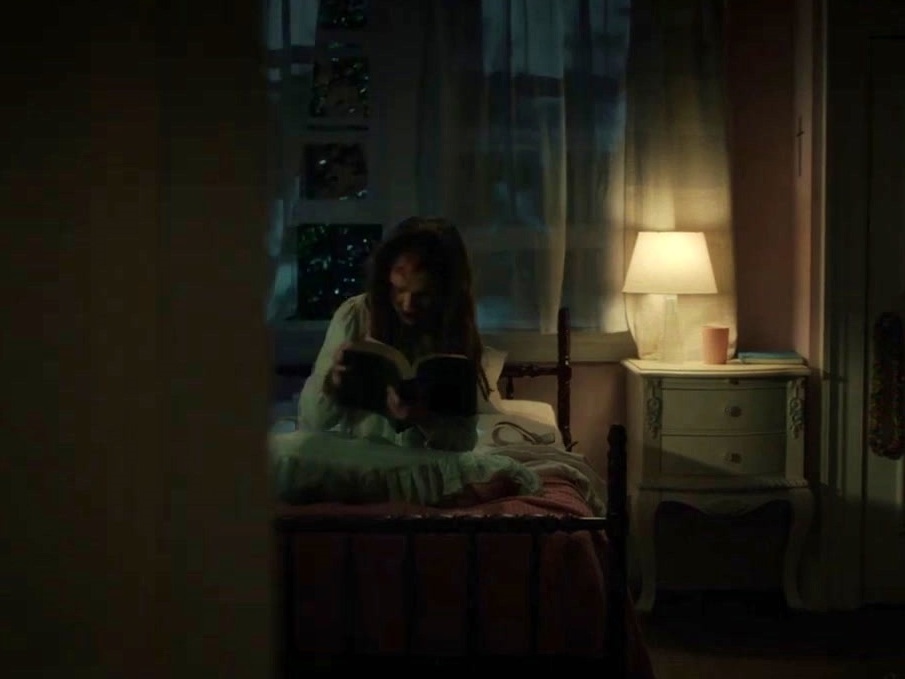 So, there may be much which makes no sense in Believer’s muddled scenario, that was simply intended to lay the groundwork for future payoffs. But the uncertainty fails to do this first film any favors. (Its shaky performance at the box office has also put the fear of God in the filmmakers, with talk now about taking the future films in a different direction.). Nothing comes of the scenario’s suggestion that the Chris character needs to ‘open her eyes’ to find her lost daughter, for instance. On the face of it, her unnecessary scourging ends up having little whatever to do with the rest of the film, so there’s no point trying to puzzle out its purpose. We’d need a God’s-eye-view.
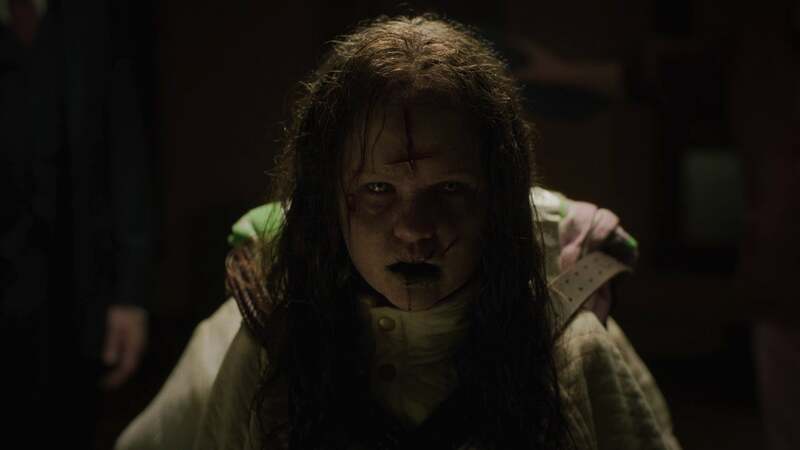 Olivia O‘Neill, who plays one of the afflicted girls, Katherine, seems to have been specifically cast due to her strong resemblance to a little Linda Blair. And through shrewd framing, makeup and shadowy low-lighting, the movie tries to blur our memories of the original Exorcist with the similar visuals in this one. But her big confrontation with Burstyn has, inexplicably, been plunked right down in the middle of the movie, like the chariot race in Ben-Hur, after which the drama continues limping on for another hour or so afterward. With so much of Green’s insidious imagery intended to evoke the earlier film, when Katherine giddily reaches for that familiar, shiny little crucifix to start violently jabbing away again, we’re given pause. Because suddenly we realize how much movies have changed since the graphically realistic era of the early ‘70s that the original Exorcist emerged out of. And how chastely circumspect today’s slickly polished, airbrushed variations on the theme have become by comparison.
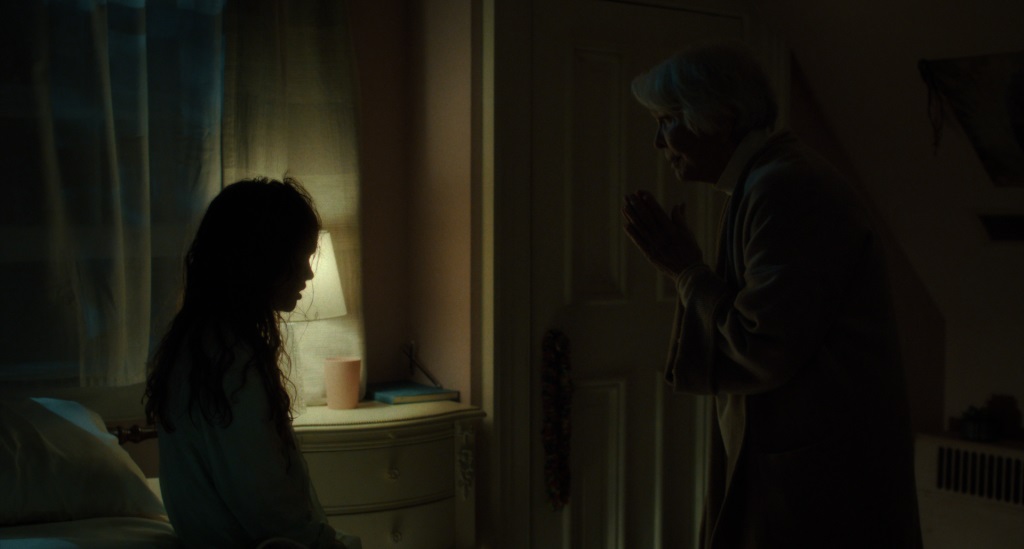 Rather than daring to hold itself up as a sequel worthy of being whispered in the same breath as the original, Believer is a truly astonishing case study in carefully inoffensiveness moviemaking. Though it never reaches the enjoyably ludicrous heights of, say, The Pope’s Exorcist, which tried to make its possessed little boy sound lewd and appear intimidating, though he couldn’t have amounted to more than 50 pounds soaking wet, Believer still makes it perfectly clear why none of these exorcism movies have ever really worked since the original.
The 1973 Exorcist was directed by William Friedkin, who just died this past summer and was, at the time, still sizzling hot off his Oscar-winning Best Picture, The French Connection, which had been shot in a strikingly realistic, docudrama style intended to blur the line between fact and fiction. Friedkin, who came from a background in
Rather than daring to hold itself up as a sequel worthy of being whispered in the same breath as the original, Believer is a truly astonishing case study in carefully inoffensiveness moviemaking. Though it never reaches the enjoyably ludicrous heights of, say, The Pope’s Exorcist, which tried to make its possessed little boy sound lewd and appear intimidating, though he couldn’t have amounted to more than 50 pounds soaking wet, Believer still makes it perfectly clear why none of these exorcism movies have ever really worked since the original.
The 1973 Exorcist was directed by William Friedkin, who just died this past summer and was, at the time, still sizzling hot off his Oscar-winning Best Picture, The French Connection, which had been shot in a strikingly realistic, docudrama style intended to blur the line between fact and fiction. Friedkin, who came from a background in 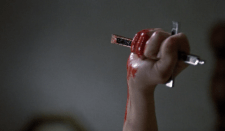 documentaries, helped pioneer and popularize this new look of ‘70s American cinema. And it was specifically its quality of authenticity that made the original Exorcist seem so credible and powerful, what had people reportedly throwing up and fainting in the aisles. As commentators noted at the time, no other mainstream American movie had presented such graphic language and imagery to a widespread audience. Not even the X-rated Oscar winner Midnight Cowboy, a few years earlier.
No horror film had ever taken itself that dead seriously before. And most viewers weren’t prepared for the harsh realism of such an explicit presentation, which seemed to hold nothing back. How far it went was considered truly shocking for the time. But alas, times have changed. Director Green never attempts to use the tools of his trade to convince us, stylistically speaking, that what we’re seeing is real. Instead, he’s had cinematographer Michael Simmonds shoot the movie in a glibly professional manner, in order to make it look like any other entry in The Conjuring franchise.
documentaries, helped pioneer and popularize this new look of ‘70s American cinema. And it was specifically its quality of authenticity that made the original Exorcist seem so credible and powerful, what had people reportedly throwing up and fainting in the aisles. As commentators noted at the time, no other mainstream American movie had presented such graphic language and imagery to a widespread audience. Not even the X-rated Oscar winner Midnight Cowboy, a few years earlier.
No horror film had ever taken itself that dead seriously before. And most viewers weren’t prepared for the harsh realism of such an explicit presentation, which seemed to hold nothing back. How far it went was considered truly shocking for the time. But alas, times have changed. Director Green never attempts to use the tools of his trade to convince us, stylistically speaking, that what we’re seeing is real. Instead, he’s had cinematographer Michael Simmonds shoot the movie in a glibly professional manner, in order to make it look like any other entry in The Conjuring franchise.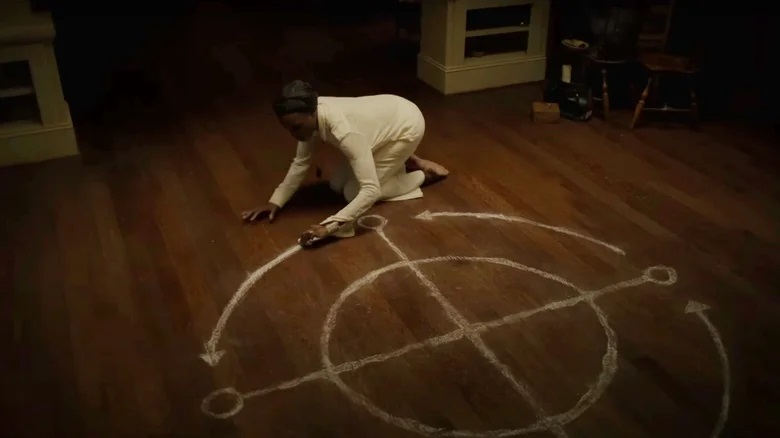 Even if adult doubles were used for the more explicit moments, the dubious casting of underage actresses like Linda Blair, Brooke Shields and Jodi Foster in rather prurient roles during the ‘70s might seem more suspect today, when no big, or even moderately, budgeted movie would dare chance the accusation of child exploitation, for fear of the backlash and negative impact on the box-office. But it’s surprising that none of these exorcist movies appear to have realized that this very fear is what defangs their subject now – their hand wringing, knee-knocking the only evidence of Satanic panic onscreen or off. What was so frightening about the original was watching, in slowly escalating,
 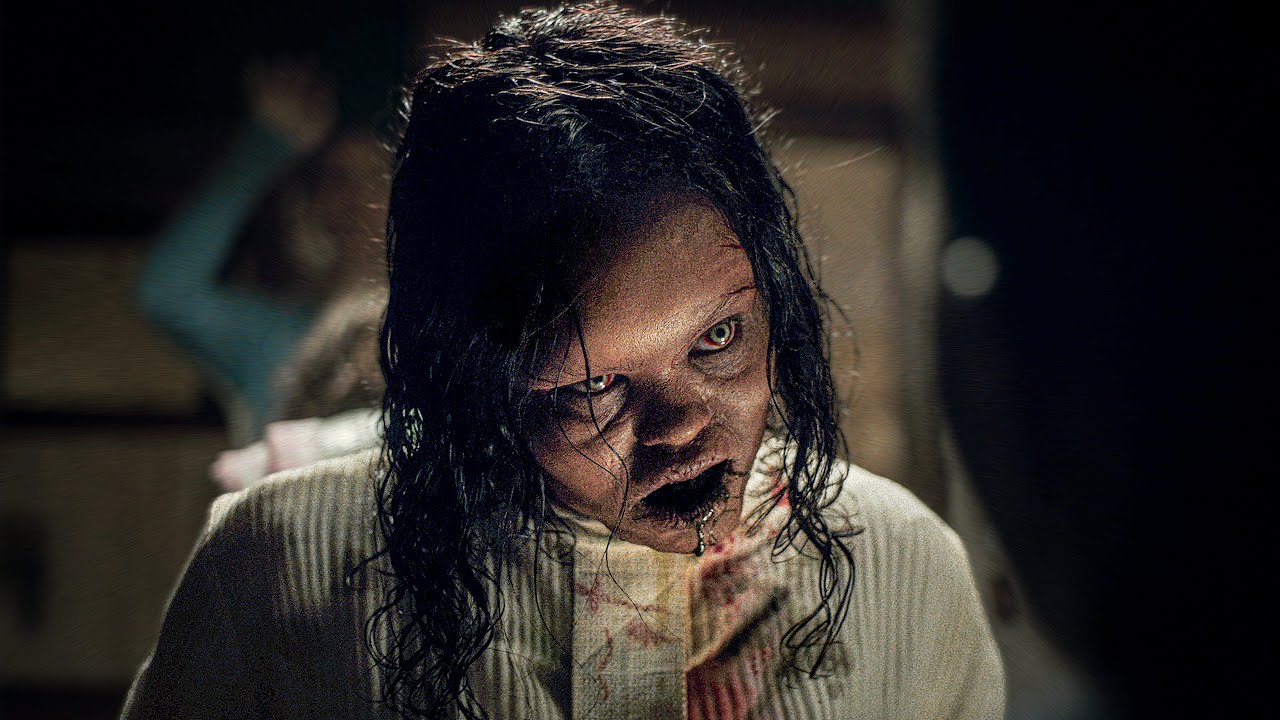 graphically realistic detail, a child morphing into a demonic monster before our eyes – tapping into every parent’s greatest fear of their sweet and innocent little angels rapid-aging into sexually promiscuous, foul-mouthed teens. Watching demon-ravaged Regan’s trussed up body tied down in the station of the cross, while being scourged and desecrated in ways purposely meant to imply violent sexual assault, left us feeling as helpless as her mother, as we listened to her screams. But there’s no way movies would dare try to approximate that now, without leaving viewers so uncomfortable they became queasy, in a way the original movie didn’t mind making them. The last thing in the world an unapologetic cash grab like Believer wants is to make its intended audiences uncomfortable. It’s far more terrified of that than the legions of demons it trots out for show.
 Here, the isolated attempts to make the girls seem unnaturally salacious are so tepid it’s just embarrassing. And there’s no actress the caliber of Mercedes McCambridge to cover over the patches by providing the more demanding vocal effects (the demon voices are rendered here by Helen Leahey, Christopher Allen Nelson and J. Moliere). At times, the harshly guttural demon even affects a hilarious, hoity-toity British accent to imitate Burke Dennings, whose character is never referenced in this film, not even to address the long-standing question about what he was doing up in Regan’s room in the first place.
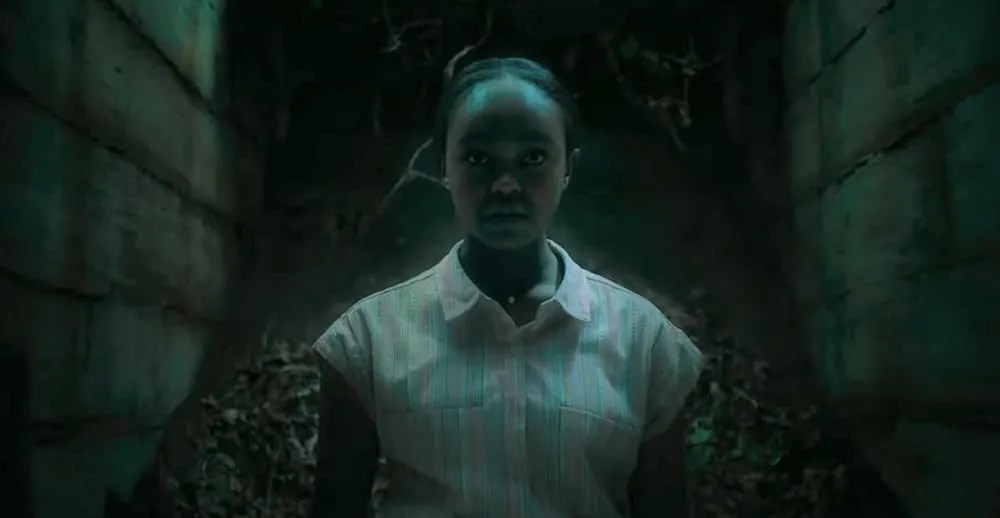 Believer is perhaps at its best or, at least, its most harrowing early on, when the girls have just gone missing. The police procedural aspects are unsettling because they remind us of so many real-world, true crime cases in which milk carton kids are never found. Also fascinating is the fallout on the two sets of parents as they simultaneously bond with one another, as the only people who can understand what they’re going through, being in the same situation themselves, and turn against each another, assigning blame for what happened to the only convenient target in their line of sight, with no perp having yet been identified. This part is at least on par with Denis Villeneuve’s expert Prisoners. But since we know there can be no exorcism if the girls don’t return, there’s no real suspense in this section, since there’s no doubt about the outcome.
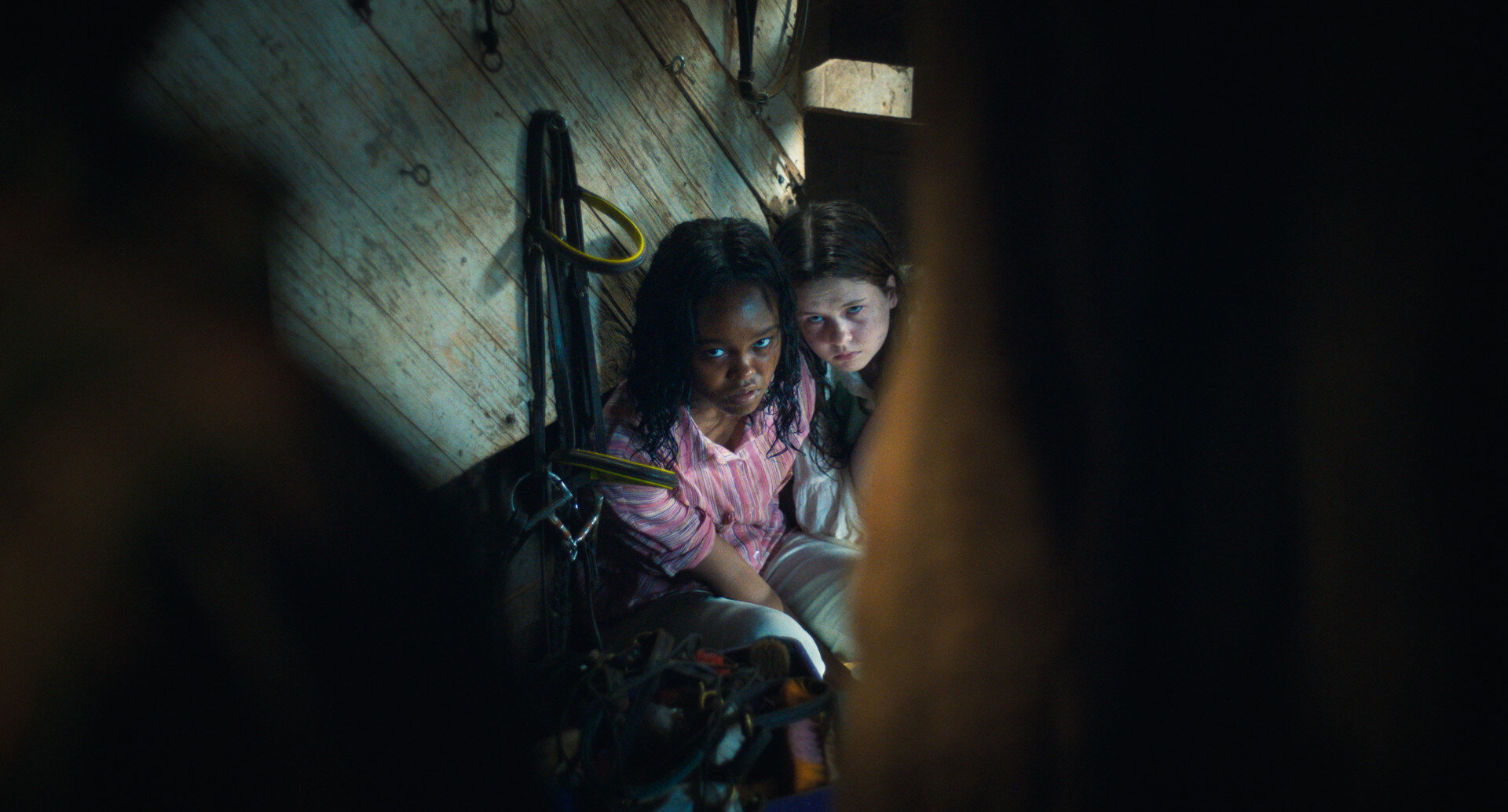 And when they are found they’re conveniently amnesiac, Picnic at Hanging Rock-style. So, we never learn exactly what happened to them out there, leaving the mystery, which should be cut and dried, unsolved. Why did that apparent invocation they performed, so the bereft Angela (played by Lidya Jewett) could contact her dead mother (played by Tracey Graves), set them aimlessly wandering through the woods for three days? This element doesn’t match up with anything else ever defined in the exorcism cannon. It seems to have been borrowed from Missing 411 mythos. And since the sound was so muffled by the rain, I wasn’t sure what the carcass of that mutilated horse was supposed to signify. I’m assuming their disappearance wasn’t meant to be linked to alien abduction.
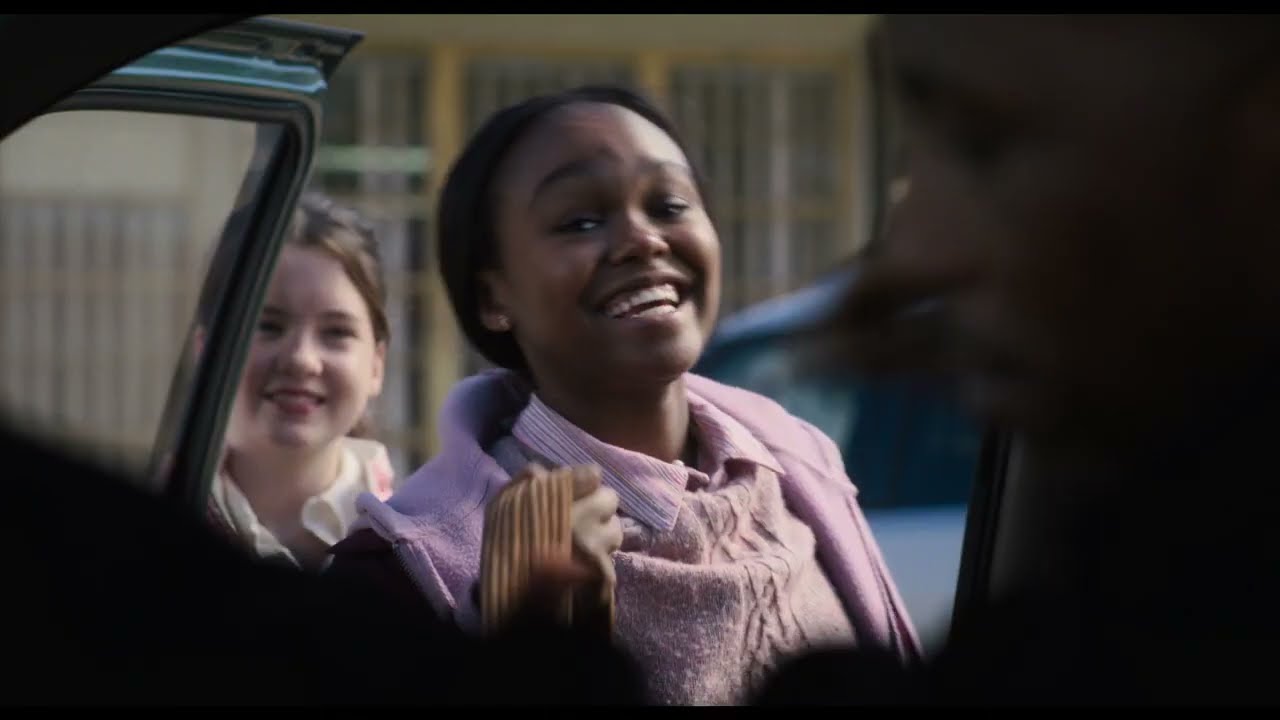 The only unique vantage evident in Believer, unfortunately, is the shifting of races, so that the overly familiar events are now presented from the point of view of black characters. But the way things play out, they bring no new shadings to proceedings, as we’re led to believe they might, early on, with that intriguing prologue set in Haiti. There was some purpose to having the original movie open in Iraq, in the midst of an archeological dig. But our demon here doesn’t turn out to hail from any specific region of the world, though it might have been more interesting if it had.
The black roles might as well have been written for white characters to play. They’re as racially indistinct as the representative religions. And when the parents start panicking over the missing girls and tempers explode, things don’t reach a racist level of insults and antagonisms, the way lived experience tells us they would, given society’s current culture war tensions. At the very least, the racial disparity of the two victims here should have prompted the movie to point up the prominence corporate media typically places on missing white girls, as opposed to those of other races.
The only unique vantage evident in Believer, unfortunately, is the shifting of races, so that the overly familiar events are now presented from the point of view of black characters. But the way things play out, they bring no new shadings to proceedings, as we’re led to believe they might, early on, with that intriguing prologue set in Haiti. There was some purpose to having the original movie open in Iraq, in the midst of an archeological dig. But our demon here doesn’t turn out to hail from any specific region of the world, though it might have been more interesting if it had.
The black roles might as well have been written for white characters to play. They’re as racially indistinct as the representative religions. And when the parents start panicking over the missing girls and tempers explode, things don’t reach a racist level of insults and antagonisms, the way lived experience tells us they would, given society’s current culture war tensions. At the very least, the racial disparity of the two victims here should have prompted the movie to point up the prominence corporate media typically places on missing white girls, as opposed to those of other races.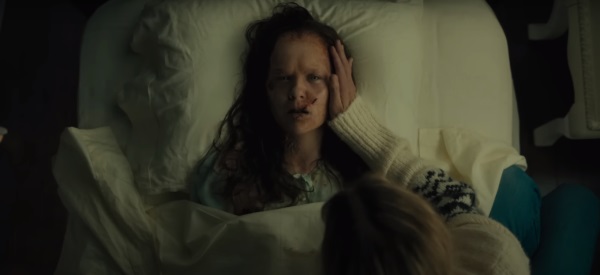 But as the search wraps up, the script never sprinkles in any tell-tale signs that should have been adding up in this regard. Instead, it waits all the way until the very end, during the exorcism finale, to point up the greater stress placed by our society on ensuring the safety of white lives, as opposed to those of black ones. We get to know little of daughter Angela before she’s possessed, so we don’t really have time to emotionally invest ourselves in the character to the degree we should. Consequently, we can’t work up the requisite emotion demanded for her, as an individual, when she’s meant to be suffering.
We only feel pity for her the same way we would any other stranger we’d ambiently heard about in the news. The other possessed girl comes off even worse, she’s treated like an afterthought. As Angela’s father, Victor Fielding, Hamilton legend Leslie Odom Jr., who was so good as Sam Cooke in One Night in Miami, brings a blessed stillness to his role, which helps to anchor the drama. He remains the becalmed center of the storm when everything around him starts swirling into melodramatic overdrive. So, Odom is never lowered to the movie’s own level.
But as the search wraps up, the script never sprinkles in any tell-tale signs that should have been adding up in this regard. Instead, it waits all the way until the very end, during the exorcism finale, to point up the greater stress placed by our society on ensuring the safety of white lives, as opposed to those of black ones. We get to know little of daughter Angela before she’s possessed, so we don’t really have time to emotionally invest ourselves in the character to the degree we should. Consequently, we can’t work up the requisite emotion demanded for her, as an individual, when she’s meant to be suffering.
We only feel pity for her the same way we would any other stranger we’d ambiently heard about in the news. The other possessed girl comes off even worse, she’s treated like an afterthought. As Angela’s father, Victor Fielding, Hamilton legend Leslie Odom Jr., who was so good as Sam Cooke in One Night in Miami, brings a blessed stillness to his role, which helps to anchor the drama. He remains the becalmed center of the storm when everything around him starts swirling into melodramatic overdrive. So, Odom is never lowered to the movie’s own level.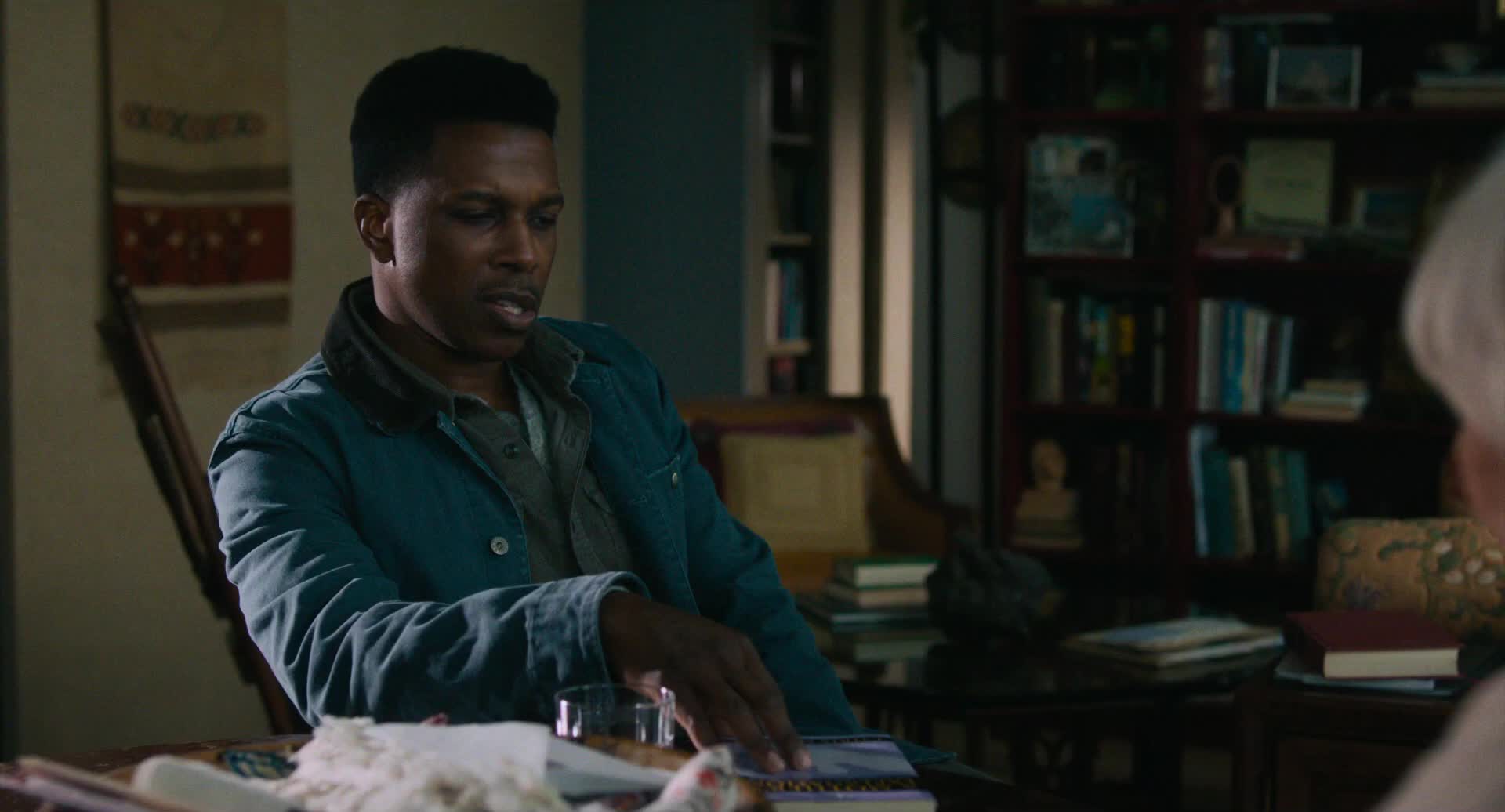 In the fifty years since the original Exorcist, Linda Blair has been supplanted in the mind by so many lookalikes and imitators (perhaps most successfully Samara from The Ring), we’ve developed almost a fondness for the character, the way we do when watching old Frankenstein or Wolfman films. So, when young actresses are required to imitate the real deal, as both young victims are here, it seems almost sacrilegious. Perhaps that’s why they doubled the effect, diabolism times deux, thinking two Blairs would be more persuasive than one. When they’re both seated back-to-back, and their heads snap around and sort of entwine into one another, like a snake pit from the overhead shot, they form a yin and yang pattern. Though the movie never bothers parsing out the meaning of this reoccurring twinning motif, we see the men carrying a large mirror out of the house prior to the exorcism.
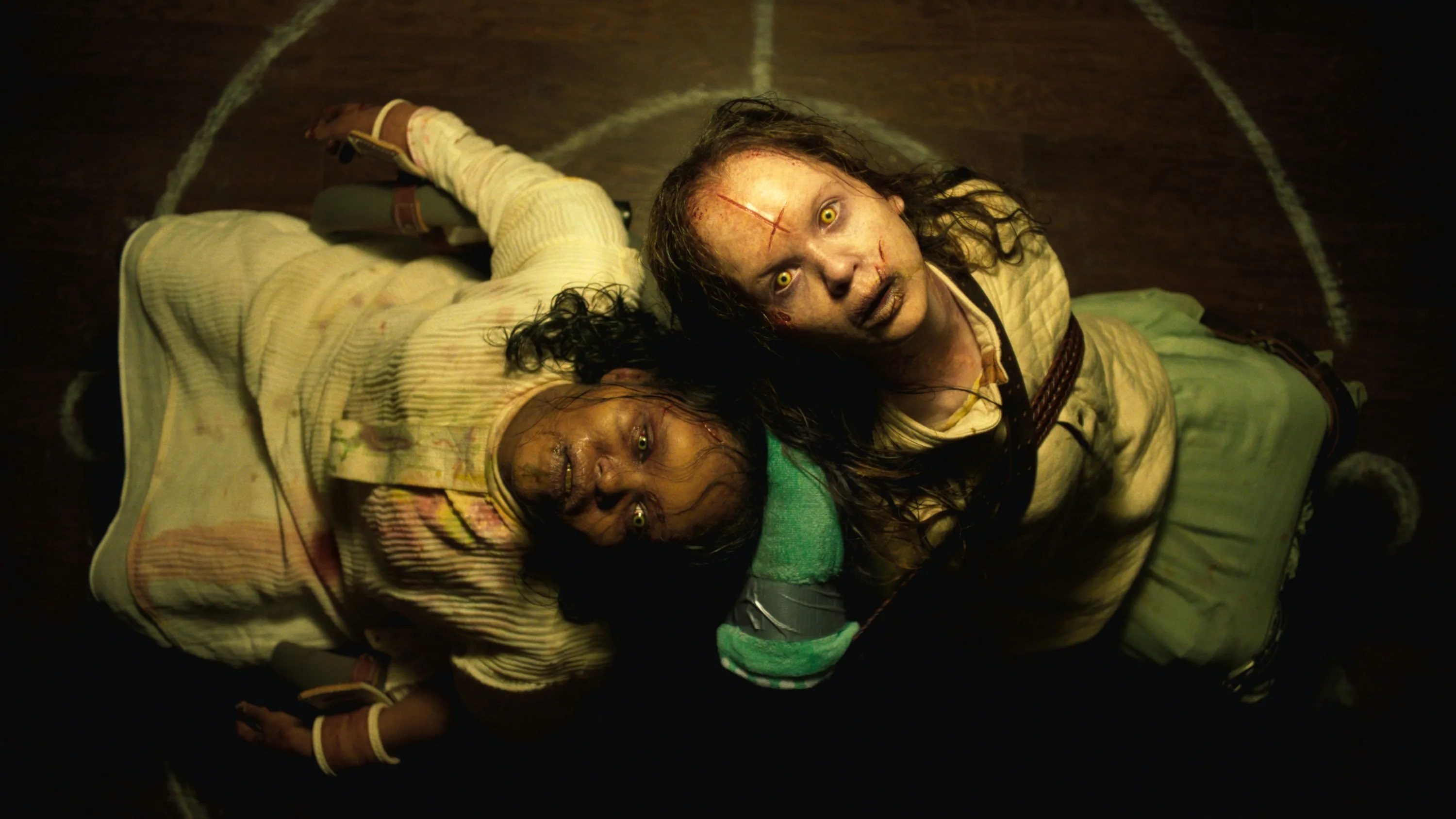 There’s definitely a doubling effect in evidence here, with repeated reference to babies being ripped from their mothers’ wombs, with Ann having had an abortion and Angela being born premature when her dying mother was injured in an earthquake. But when we’re told only one of the girls can survive, cleaving them in two, we wonder why everyone involved is immediately okay with letting the devil determine those odds. But by that point in proceedings, we know better than to expect that scriptwriters Green and Peter Sattler (from a story by Green, Danny McBride & Scott Teems) will come up with anything clever and original, since they’ve long since fallen lazily back on the tried and true. Instead of the wisdom of Solomon, we get a ham-handed Sophie’s Choice, without much sense made of the why and how come, or how it interrelates with that original choice Victor had to make between saving his wife or saving his daughter.
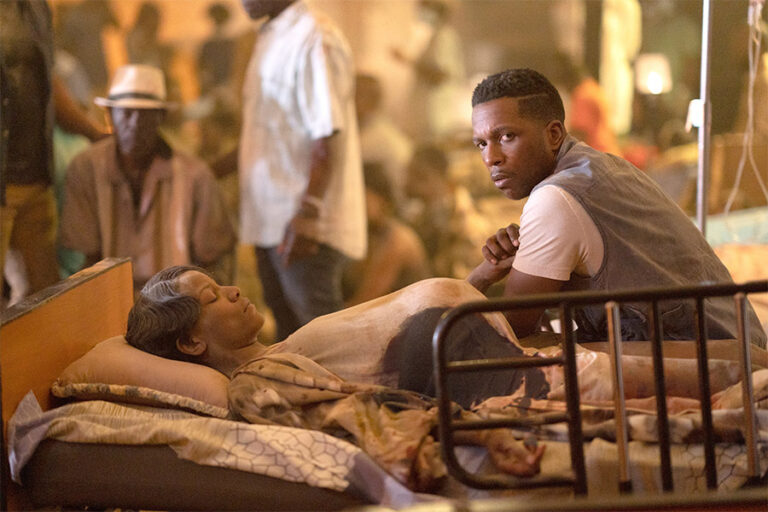 And for some reason the women are made to suffer for the selfishness of Katherine’s father (played by Norbert Leo Butz), whose behavior condemns them all. And if the devil can cavalierly pop up at this party uninvited, it seems a bit cruel that the mother Angela was reaching out to in the first place, never does. Not even to protect her baby girl, as Lin Shaye’s did in The Last Key. Plot armor ensures we know who will survive these uneven odds, but the question is why the immortal soul of the other little girl, through no fault of her own, is treated so cruelly (it’s like the film were working out some lingering ill will over what she did to Chris). As he did with Michael Myers in Halloween Ends earlier in the year, Green has deemed himself the one director in modern cinema worthy of laying all the endless Regan imitators permanently to rest.
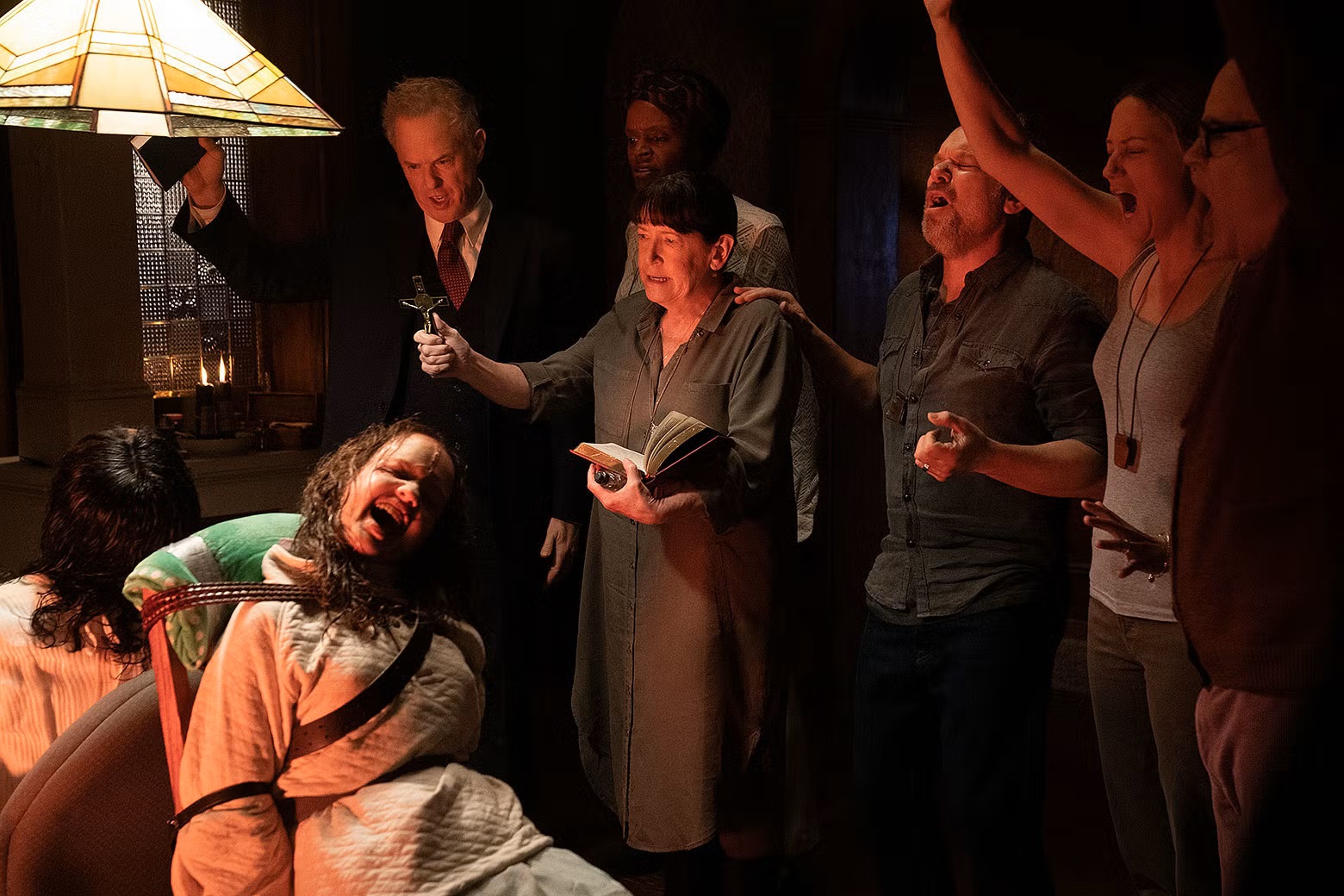
 As a subgenre, exorcism movies all bespeak a woeful lack of imagination on the part of their makers, and Believer is no different. Invariably they follow the exact same shtick, in which a child (when feeling really racy they’ll make it a little boy, as in the original case study that inspired William Peter Blatty’s book), becomes possessed, bedridden and must be cured, usually through some form of Christian Science. What’s funny, and ultimately inexplicable, about Believer is that Catholicism is no longer depicted as the One True religion capable of casting out demons, as it is in most other exorcism and Nun movies, right back to the original. Chris repeatedly claims, based on her globetrotting travels that all cultures and faiths have their own forms of exorcism. And her big speech about coming together is the catalyst intended to unite the warring religious factions which have all been separately trying to exorcise the girls’ demons to prove the superiority of their faiths. It sets the proper mood to allow them to finally pool their individual
 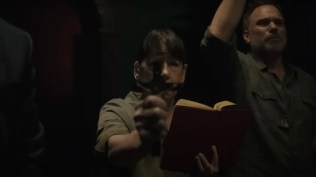 strengths, doing together what they’d each failed to do alone. It’s purposely not stressed what precise denomination each is representing, since they’re meant to be more representative of familiar, if unspecified, religions. Each has deliberately been made to seem generic, so they can stand in for all denominations. It’s a very Unitarian Universalist approach, though we don’t see any sample, say, Muslims or Buddhists in attendance. The Pentecostal religion the neighbor Stuart (played by Danny McCarthy) is part of seems more holistic than evangelical (there’s also a gym scene inserted that suggests he’s Victor’s boxing manager, which is apropos of nothing else in the movie). While rootwork healer Dr. Beehibe – her real name in the film (played by Okwui Okpokwasili) – incorporates elements of shamanism and voodoo. Katherine’s parents attend a standard issue Baptist church presided over by Pastor Don Revans (played by Raphael Sbarge)
 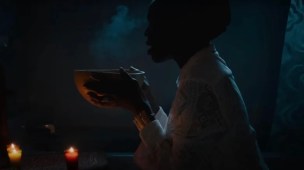 that might be mistaken for any other protestant denomination. It appears to be sandwiched somewhere between midtown and megachurch. Ann is a relapsed Catholic. While Victor is meant to stand in for the agnostic Chris character from the original movie, whose traumatic experience brought her closer to God. But despite all the indeterminate and nondenominational faiths amassed to fight the demon at the end of Believer, it’s still only the appearance of the Catholic priest (played by E.J. Bonilla) that imparts the impression of having any appreciable command. But then he’s dispatched peremptorily in a way that seems mockingly intended to scream couldn’t-forget-our-signature-move. And after twisting his head like a cap off a bottle, he’s promptly forgotten about by the script. Despite Katherine’s mother Miranda (played by Jennifer Nettles) having declared that Christ descended to Hell in the three days prior to his resurrection to declare his dominion over Satan, it’s the devil who ultimately gets his due here.
 The original movie sent scores of viewers who had lost their religion scuttling back either to God or into therapy. But none of the various faiths that take a turn on Believer’s carousel appear to have any effect, so there’s no real feel for established religion, or any other, apparent here. Despite its title, Believer puts no real stock in anything much, leaving those of us who might have wanted to believe in something feeling bereft and abandoned, like there’s no comforting religion with any power for good in the world left to believe in. And if the film leaves us with nothing to believe in except for talismans and our own resourcefulness, who then, pray tell, is supposed to be the true Believer?
 The only thing that seems certain is how the moviemakers expose themselves as philistines at work, money changers in the temple whose only faith is in the box-office, their great golden calf, their only prayers being sent up for an impressive opening weekend haul. Religion is just used as background filler for a silly Hollywood spook show, like those seasonal Hell houses that churches set up around Halloween, with the intention of scaring kids straight. At the end, Green remains as agnostic as parents Victor and Chris were, at the outset. Victor, and to a lesser degree Ann, are the only people involved in the exorcism whose supernatural experiences are intended to restore their faith, like Karras in the original. And I’m sure even afterward they’d both describe themselves as ‘spiritual’ rather that devout.
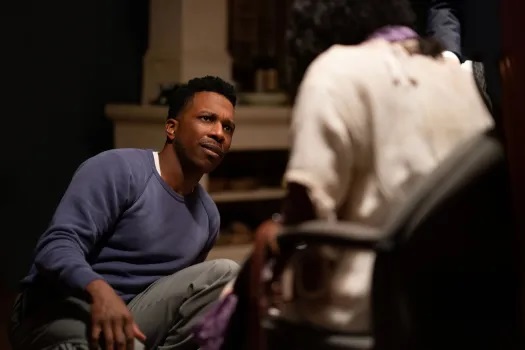 The original Exorcist was a deeply conservative film that showed an America on the verge of collapse. The country seemed splintering apart in the era of Vietnam, Watergate, and in the wake of all the political and social unrest of the ‘60s. The type of world situation religious pundits have always warned us signals the End of Days and coming Armageddon, during which the devil will be unchained to stalk the earth for a thousand years (according to your own given denomination). Believer likewise wants to draw a direct parallel between that time and this, with our own widening culture wars and political schisms reaching a boiling point, unseen in this country since the early ‘70s.
Burstyn’s big speech about bringing people together seems intended to speak directly to the increasing sense of isolation that has cropped up, especially since COVID distancing measures were put in place, contributing to that growing gulf and chipping away at our sense
The original Exorcist was a deeply conservative film that showed an America on the verge of collapse. The country seemed splintering apart in the era of Vietnam, Watergate, and in the wake of all the political and social unrest of the ‘60s. The type of world situation religious pundits have always warned us signals the End of Days and coming Armageddon, during which the devil will be unchained to stalk the earth for a thousand years (according to your own given denomination). Believer likewise wants to draw a direct parallel between that time and this, with our own widening culture wars and political schisms reaching a boiling point, unseen in this country since the early ‘70s.
Burstyn’s big speech about bringing people together seems intended to speak directly to the increasing sense of isolation that has cropped up, especially since COVID distancing measures were put in place, contributing to that growing gulf and chipping away at our sense 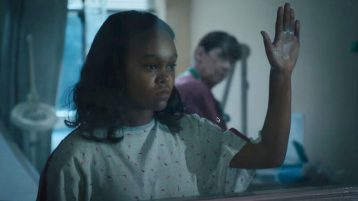 of shared community, friendships, family, churches, schools, all the institutions and bulwarks of society that traditionally helped people socialize, stay connected, and find common ground, making them feel close to their neighbors, invested in their communities and committed to taking part in their civic duties. But Believer fails to fully clarify even the most basic, invisible details. When the Fielding’s neighbor across the way initially appears, complaining about the garbage cans left on the street, it’s not until later that we realize it was actually Ann. Not only does she live right next door, but she’s also a nurse at the hospital Angela is taken to as well. Why is it made to seem like the daughters purposely kept the fact that they were friends away from their parents, when Katherine was seen greeting Victor when he dropped Angela off at school? And when a point is made that vegan Angela no longer eats meat, discarding the sausage that her father serves for breakfast, we have every right, when she returns, to expect her to ask where’s the beef, just to mark the change in her character. But she never does.
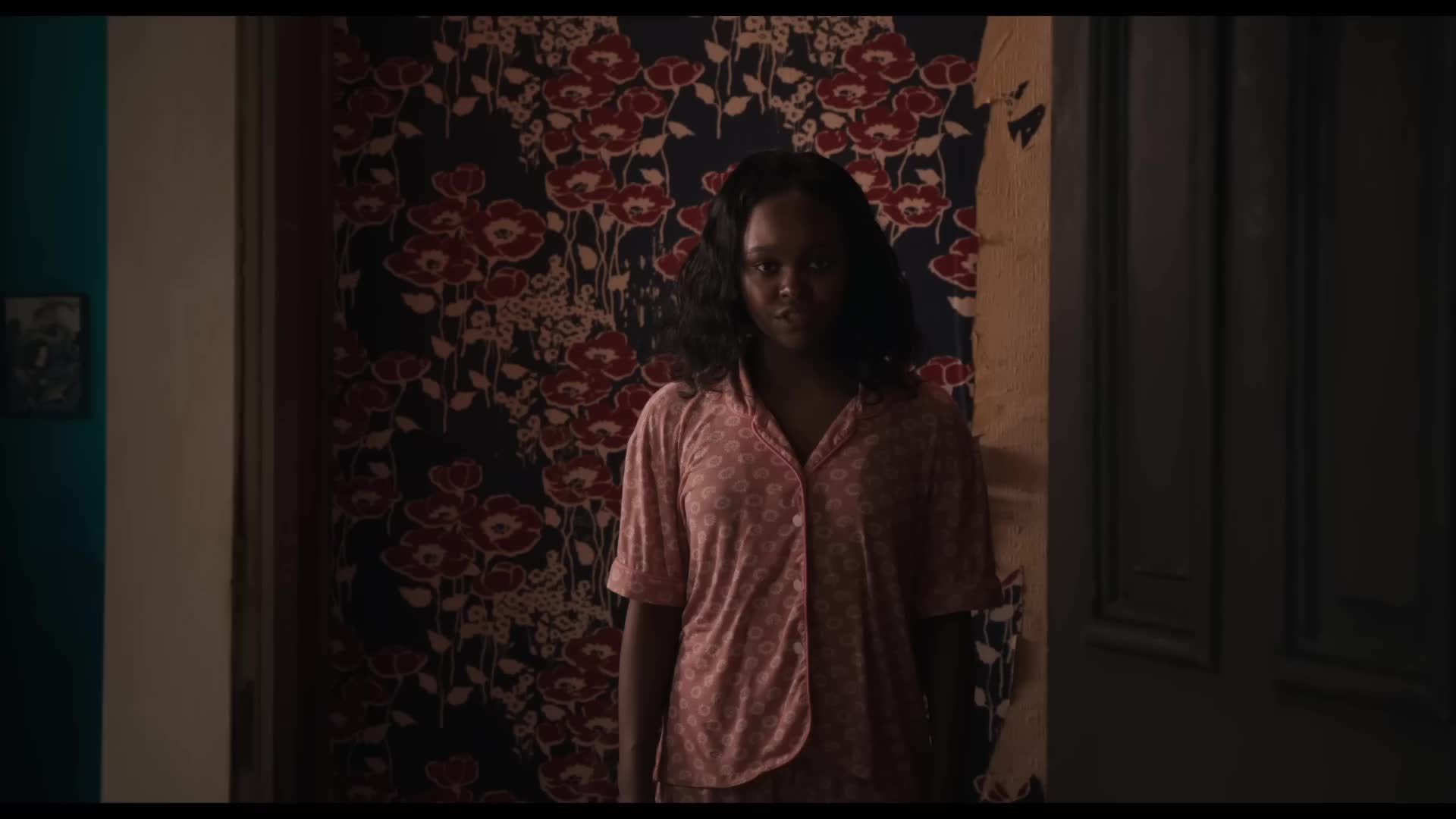 When her bathtub mysteriously fills with muddy water, and Angela suddenly goes missing again, we sit there dumbfounded as to why her father doesn’t do the obvious thing anyone else would, and stick his hand beneath the surface to see if she’s drowned in there, before he starts searching the house for her. One could construe that the Victor Fielding character was named for Victor Frankenstein, but you’d have to consult a crystal ball to figure out what was intended by that. The movie doesn’t attempt to make any correlation between his job as a photographer and Chris’ lack of sight. It never even makes it clear precisely who this demon is supposed to be. We must assume it’s not Pazuzu. And at the end of the exorcism, we wonder, given the amassed death tally, if these laypeople have ever heard of Anneliese Michel, whose tragic demise the popularity of the original Exorcist probably had more than its fair share to do with.
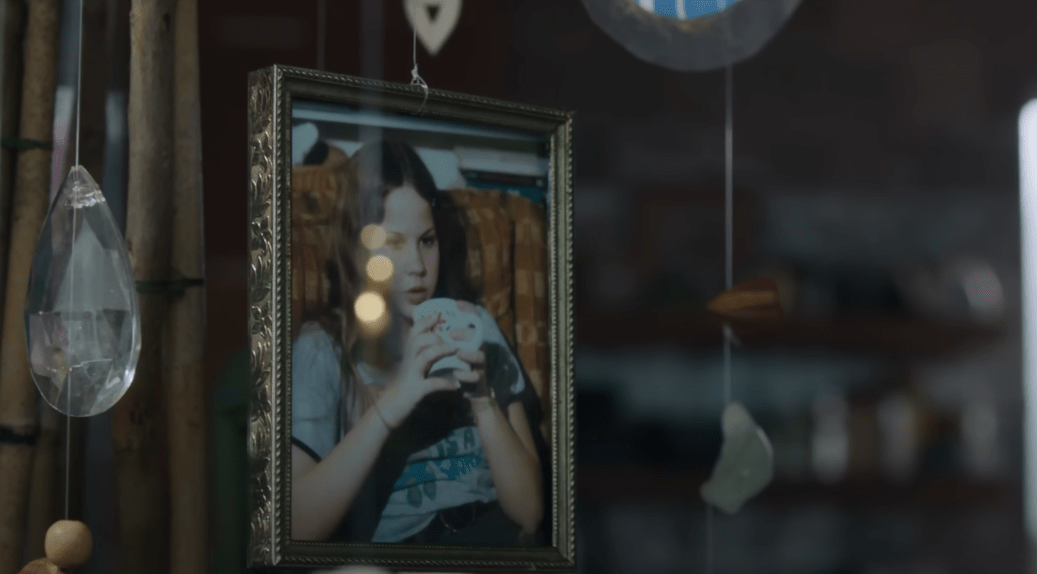
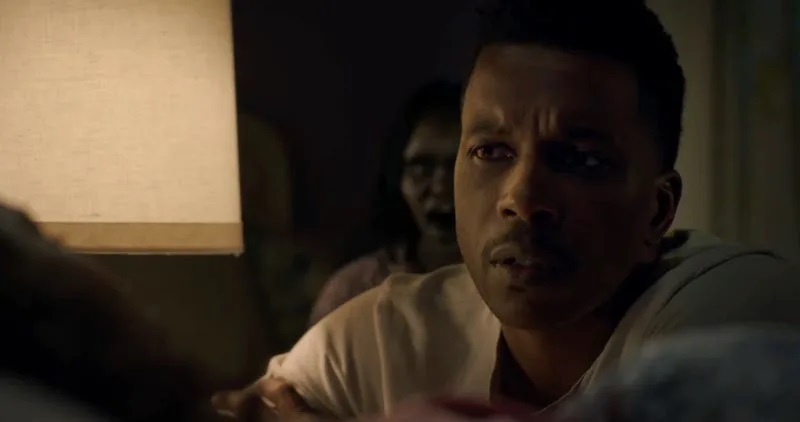 Believer is as much an homage to the original as a direct sequel to it. It keeps trying to hit the same major beats, without providing any of the necessary context. At the same time, the movie doesn’t mind pulling in elements, even jump scares, from just about all over, dipping in and out of a hodgepodge of other horror films released over the intervening years. Early on, widower Victor sees that the portraits he’s taken of the ‘perfect’ nuclear family, have been warped. But since nothing further comes of this, we’re left to assume the movie must have gotten its wires crossed with The Ring for some unfathomable reason. There’s the shock shot of the demon standing directly behind the father, whose framed precisely like Patrick Wilson was, when that red Lipstick-Face Demon first appeared behind him in Insidious.
There’s the expulsion of ectoplasm from the mouth, which just kind of roils and twines like a constrictor, as we’d seen in The Haunting in Connecticut and a host of other movies. This gambit has become such a given, it even upstages the classic pea soup bit, when that’s dredged back up. Even Drag Me to Hell is referenced by the end. The Exorcist was better than this. The Exorcist preceded all this, with few cinematic precedents of its own to draw upon for inspiration at the time. It’s the law of diminishing returns. Why can’t the movies ever let a good horror film rest in peace?
Believer is as much an homage to the original as a direct sequel to it. It keeps trying to hit the same major beats, without providing any of the necessary context. At the same time, the movie doesn’t mind pulling in elements, even jump scares, from just about all over, dipping in and out of a hodgepodge of other horror films released over the intervening years. Early on, widower Victor sees that the portraits he’s taken of the ‘perfect’ nuclear family, have been warped. But since nothing further comes of this, we’re left to assume the movie must have gotten its wires crossed with The Ring for some unfathomable reason. There’s the shock shot of the demon standing directly behind the father, whose framed precisely like Patrick Wilson was, when that red Lipstick-Face Demon first appeared behind him in Insidious.
There’s the expulsion of ectoplasm from the mouth, which just kind of roils and twines like a constrictor, as we’d seen in The Haunting in Connecticut and a host of other movies. This gambit has become such a given, it even upstages the classic pea soup bit, when that’s dredged back up. Even Drag Me to Hell is referenced by the end. The Exorcist was better than this. The Exorcist preceded all this, with few cinematic precedents of its own to draw upon for inspiration at the time. It’s the law of diminishing returns. Why can’t the movies ever let a good horror film rest in peace?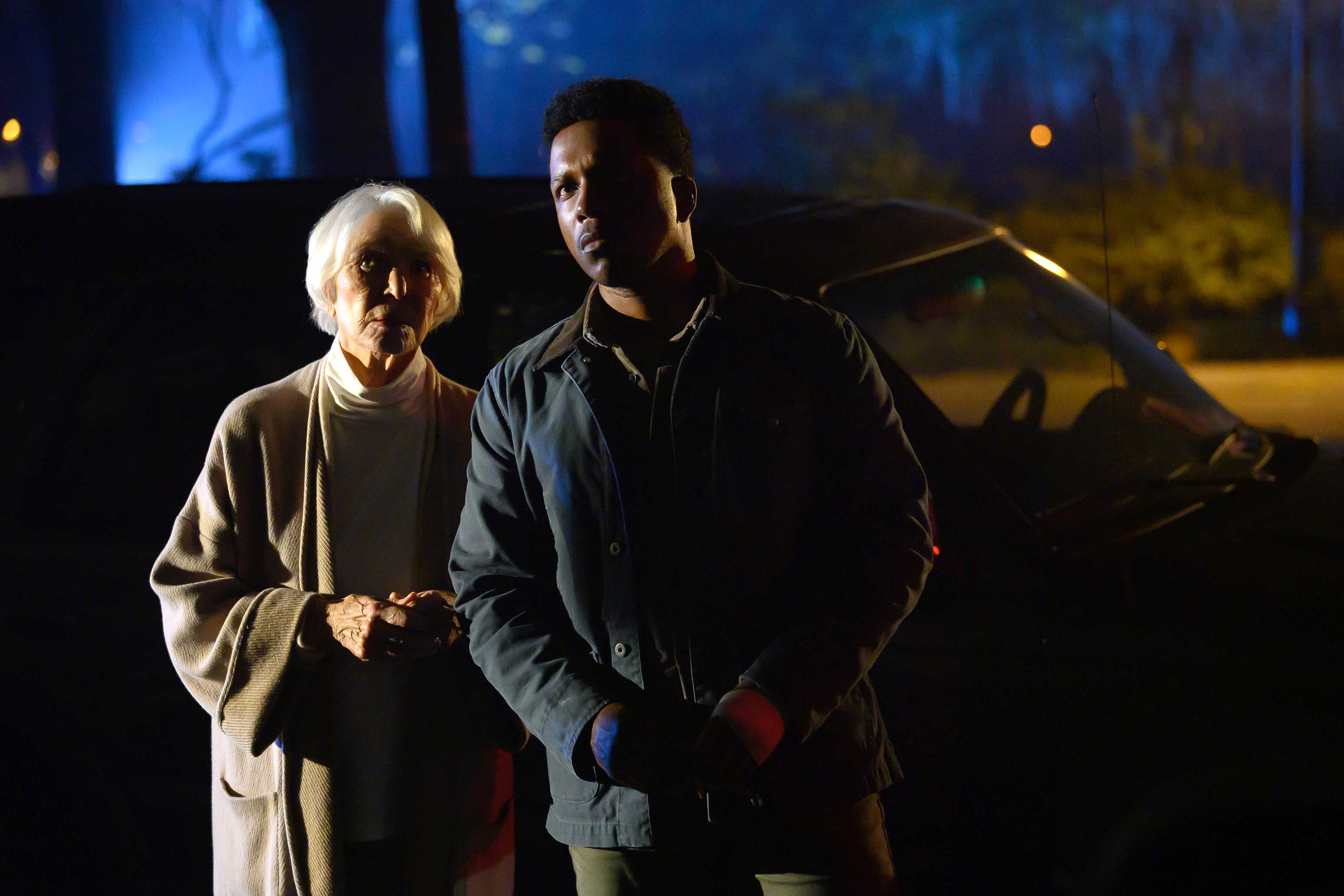 The problem with Believer, like all the other reboots and franchises and sequels it’s sharing screen space with this spooky season, is that it exerts a major mind warp on our sensibilities. Movies like this exist within their own hermetically sealed universe, one that operates according to its own internal logic. It’s a world where cultural phenomenon like The Exorcist (and the offspring it’s inspired, such as The Exorcism of Emily, The Final Exorcism, and The Pope’s Exorcist) never existed. But where the paranormal lore and logic that Exorcist movies have established over the years, all the ‘laws’ that govern the genre, are quite real and still hold sway.
The suspension of disbelief these movies require can become quite maddening, even if one rarely questions it in the moment. When the girls first begin dabbling with Ouija boards, for example, opening themselves up to demonic forces, our first thought, naturally, is ‘haven’t you seen The Exorcist?’ It’s a chancy proposition at this late stage in the day to return to your primary sources when we’ve had fifty ceaseless years of parodies, imitations and more philosophical and better made follow-ups to sift through these same circumstances.
The problem with Believer, like all the other reboots and franchises and sequels it’s sharing screen space with this spooky season, is that it exerts a major mind warp on our sensibilities. Movies like this exist within their own hermetically sealed universe, one that operates according to its own internal logic. It’s a world where cultural phenomenon like The Exorcist (and the offspring it’s inspired, such as The Exorcism of Emily, The Final Exorcism, and The Pope’s Exorcist) never existed. But where the paranormal lore and logic that Exorcist movies have established over the years, all the ‘laws’ that govern the genre, are quite real and still hold sway.
The suspension of disbelief these movies require can become quite maddening, even if one rarely questions it in the moment. When the girls first begin dabbling with Ouija boards, for example, opening themselves up to demonic forces, our first thought, naturally, is ‘haven’t you seen The Exorcist?’ It’s a chancy proposition at this late stage in the day to return to your primary sources when we’ve had fifty ceaseless years of parodies, imitations and more philosophical and better made follow-ups to sift through these same circumstances.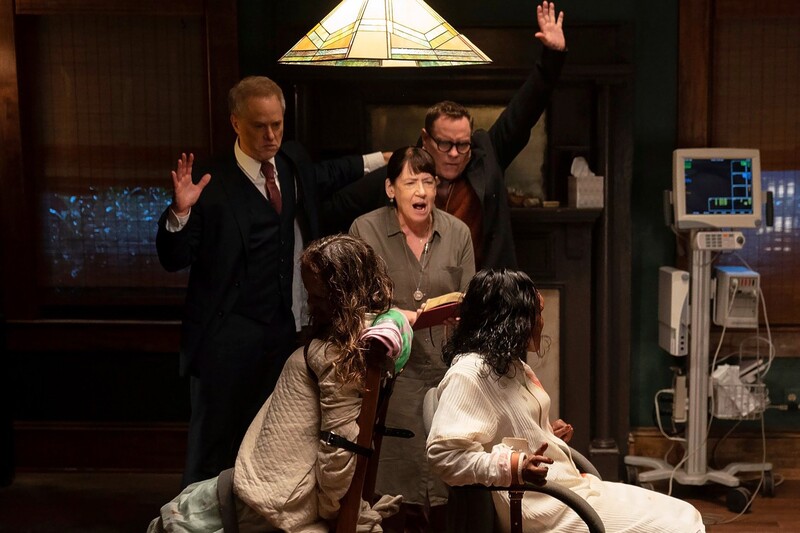 The original Exorcist tried to be many things – a Medieval miracle or mystery play, a Gothic haunted house chiller, a detective story – but, above all, it was a very Ingmar Bergmanesque treatise on the eternal battle between the sacred and profane. Which explained the casting of Max von Sydow, again squaring off with death, as he had in The Seventh Seal. But all these deep thoughts seem to have bled out over the years. Exorcism seems to have lost its punch in an increasingly secular world where garden variety acts of depravity and evil surpass anything the most creative demon could ever dream up.
Does the world really need a horned, cloven-hooved devil stomping about in the flesh; it’d seem like amateur hour compared to your everyday serial killer or political demagogue. This latest Exorcist entry is just a cheesy horror show, with delusions of being something more august, due to the esteemed company it’s keeping – horror movie royalty. But at least it’s coming out at just the right time for a scary, seasonal Halloween sugar rush, rather than the day after Christmas, like the original did.
The original Exorcist tried to be many things – a Medieval miracle or mystery play, a Gothic haunted house chiller, a detective story – but, above all, it was a very Ingmar Bergmanesque treatise on the eternal battle between the sacred and profane. Which explained the casting of Max von Sydow, again squaring off with death, as he had in The Seventh Seal. But all these deep thoughts seem to have bled out over the years. Exorcism seems to have lost its punch in an increasingly secular world where garden variety acts of depravity and evil surpass anything the most creative demon could ever dream up.
Does the world really need a horned, cloven-hooved devil stomping about in the flesh; it’d seem like amateur hour compared to your everyday serial killer or political demagogue. This latest Exorcist entry is just a cheesy horror show, with delusions of being something more august, due to the esteemed company it’s keeping – horror movie royalty. But at least it’s coming out at just the right time for a scary, seasonal Halloween sugar rush, rather than the day after Christmas, like the original did.
 CRAFT D MOVIE CRITIQUES