

BEST CHOICE:
Henry B. Walthall

 (The Avenging Conscience)
EXTANT

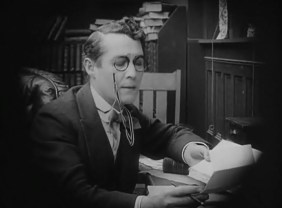 The contenders with the clearest shot at a Best Actor Oscar for 1913-14 had all built up solid reputations and faithful followings prior to the feature era. Only William Farnum could be classified a newcomer, having scored a corking success with his debut in The Spoilers. Selig’s former leading man, Hobart Bosworth had recently defected to start up his own producing concern in partnership with Jack London and was steadily adapting that author’s rugged adventure yarns to the screen, starting with a preliminary excursion in The Sea Wolf. King Baggot, another Best Actor prospect, made a stopover in England to film a popular version of Ivanhoe before continuing on to the continent where Universal intended to star him in a series of films set across Europe, plans aborted following a row with director Herbert Brenon while filming Absinthe in France. Meanwhile, Francis X. Bushman embarked upon a whistle-stop promotional tour with all the drive now associated with Oscar campaigning to win a well-advertised Ladies World popularity contest and, outdistancing closest competitor J. Warren Kerrigan, the lead in that magazine’s serialized One Wonderful Night.
But of all the likely names balloting for inaugural Best Actor honors, the most probable winner is also the least well-known now. At the time however Earle Williams enjoyed a considerable reputation as the best dressed man on the screen and was regarded as Maurice Costello’s direct successor as Vitagraph’s leading matinee idol. He’d received ecstatic notices as a disgraced man of the cloth who incorrectly prophesies the end of the world in The Christian, a Vitagraph Blue Bird Special that charged a top $1 admission price as the opening attraction at the Manhattan Opera House. In a Motion Picture Magazine poll taken a scant two years later, yet a lifetime in the days when advances in film making were being made in leaps and bounds, Earle Williams’ performance was still remembered vividly enough to be voted the greatest ever given, ever, by a screen actor up to that time.
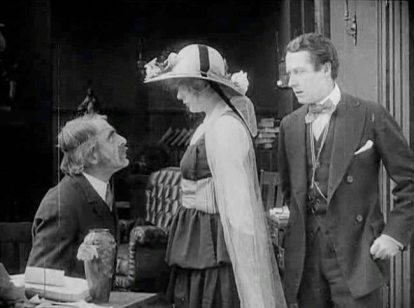
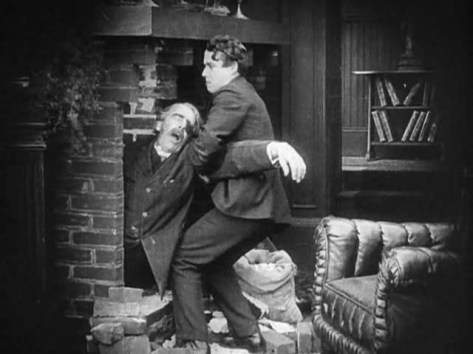
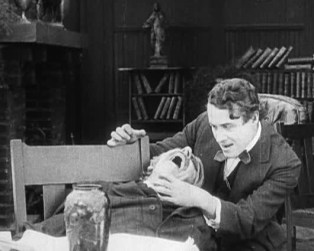 Yet there was no one more worthy of an acting award in 1913-14 than Henry B. Walthall for The Avenging Conscience, in which he gives one of early cinema’s most impressive virtuoso performances, playing a Poe-inspired murderer. And based on vintage reviews, his work would no doubt compare favorably to Earle Williams’ if The Christian still existed. His character is even wracked by a similar sense of biblical guilt after being tempted from esoteric pursuits and succumbing to the sins of the flesh, resulting in murder, insanity and suicide. Walthall plays an aspiring author whose union with sweetheart Annabel Lee (Blanche Sweet) is violently opposed by his uncle (Spottiswoode Aitken), believing it will jeopardize his dreams of becoming a great artist. Watching a spider devour a fly, The Nephew hatches a fiendish plot to murder the old man, freeing him to inherit his estate and marry the woman he loves. Walling up the body in an old stone fireplace, the guilt wracked murderer is bedeviled by the stalking specter of his uncle and blackmailed into buying the silence of an indigent Italian (George Siegmann) who witnessed everything. Alerted to his suspicious behavior, The Detective (Ralph Lewis) dogs The Nephew’s footsteps until he has him cornered. Breaking under questioning, the now insane man imagines all the sounds he hears to be the beating of the dead man’s heart. Holed up in an abandoned shack, he engages in a standoff with pursuing police but as the net tightens realizes it’s a losing battle. Learning her lover has hung himself, an inconsolable Annabel leaps to her death from a seaside cliff.
With its free associative sprinklings from “A Tell-Tale Heart” and “Annabel Lee,” The Avenging Conscience, which premiered August 2nd in New York but played Los Angeles earlier, was one of the initial West Coast releases D.W. Griffith rushed through after leaving Biograph in dispute over his desire to make longer movies. Like the director’s other intermediary features for Reliance-Majestic, it was something of a quickie job, slapped together rather haphazardly while he was preoccupied with production on The Birth of a Nation. So The Avenging Conscience is far from a perfect film (the dream ending hurts terribly), but warts and all it still affords a prime  showcase for Henry B. Walthall, a volcanic dynamo in his tour de force depiction of a deteriorating personality. Advanced as American cinema’s first feature-length horror film in the absence of the same year’s Murders in the Rue Morgue, while The Avenging Conscience has its creepy moments, the most interesting aspect of this psychological thriller in terms of the Griffith legacy is the strong emphasis on its subject’s state of mind. In an era when acting was considered more a matter of outward show Walthall attempts to internalize the process, in the interest of plumbing his character’s mental depths. The expanded running time gives him the luxury to think and reflect, exploring the psyche of a role to a far greater degree than had hitherto been attempted. Building on earlier sketches like The House of Darkness which had dealt with the institutionalized and mentally unstable, The Avenging Conscience seeks and halfway succeeds, thanks largely to Walthall’s playing and Griffith’s keen direction, in shining a light on the interior landscape, what can’t be seen and hence visualized, rather than the surface externals.
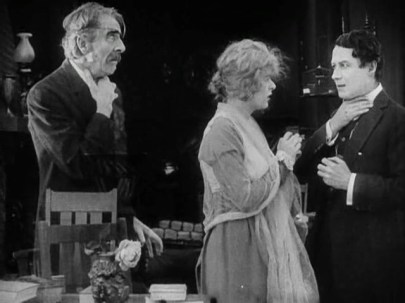
As poet Vachel Lindsay noted in his landmark treatise The Art of the Moving Picture, this is similar to what the German cinema was striving for after the war, with Walthall anticipating the grim, fatalistic work of the Expressionists. As he would in Ghosts, which introduced Ibsen to American moviegoers the following year, Walthall presents viewers with the spectacle of watching him slowly go crazy on screen, disintegrating in stages as his madness takes hold. The most impressive moments of his performance occur following the murder, this wicked deed replaying itself over and over in his mind as his avenging conscience comes back to haunt him. The actor employs a recurring gesture, unconsciously clutching his throat in fright, whenever the specter of his uncle emerges from the tomb to mockingly simulate his own strangulation. Trying to sleep off the jitters, he’s haunted by the sensation of being choked even in bed, the actor slowly registering the apparition’s appearance in stages, driving him to start up screaming before it vanishes to his intense relief. Convincing himself it was all a dream, he tries laughing it off before nervously surveying the room one last time to make sure he is alone. The intensity of Walthall’s reaction to 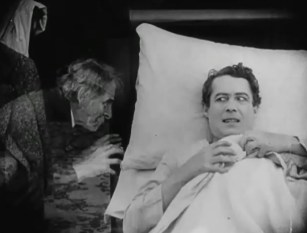 the ghostly presence is imprinted so deeply on us that by the time he encounters it during a stroll with Annabel we know precisely what he’s seeing thanks to his expert miming, even though no visuals of this visitation are offered. With eyes bulging and hands trembling, he briefly starts to come round, before relapsing and stumbling off in blind terror. In a striking scene of spiritual conversion the remorseful Nephew falls to his knees in atonement as a line from Poe is reiterated – “I saw all things in the heaven and in the earth, I saw many things in hell.” Seeking salvation he prostrates himself before religious icons, a panorama of the prophets of old holding tablets inscribed with the commandment ‘Thou Shalt Not Kill.’ Now at peace, believing the blood has been washed from his hands, a reborn Walthall is hauntingly captured in profile by a well-directed spot. Yet this nirvana is to be short-lived since the revelation of hell mentioned earlier will soon emerge to replace his evangelical ecstasy. His finest scene occurs under questioning as The Detective tries to force a confession out of him. Their Dostoyevsky inspired confrontation plays like a psychological assessment, with Walthall betraying his character’s increasing paranoia as his responses and body language are jotted down to determine his degree of guilt. Knowing his shaky mental state is being appraised makes him hot under the collar, as he feels it again constricting into a hangman’s noose.
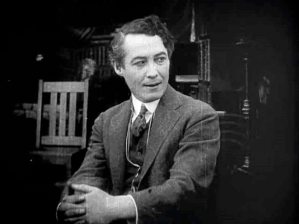 Nervously twiddling his thumbs in a semblance of unconcern, the sense of suppressed terror Walthall conveys as his fingernails dig into his skin, drawing blood, is the full equal of Mae Marsh’s famous hand-wringing during the tense courtroom trial in Intolerance. Tamped down, his eyes constantly shifting toward the door and thoughts of flight, this scene reverses Griffith’s trademark race to the rescue since the lead character would like to flee but is pinioned in place, unable to move, anticipating the climbing inflation queue from Isn’t Life Wonderful? a decade later. Walthall brilliantly suggests the already unhinged Nephew is being driven up the wall by a litany of sounds we can’t hear, such as the ticking grandfather clock, a hooting owl, a tapping foot, the drumming of the detective’s pencil on the table, which he tries to silence with an increasingly shaky hand. Griffith uses editing to augment his sensations, creating a beat, a visual rhythm (“Like the beating of the dead man’s heart.”) until it’s as unbearable for the audience as it is for The Nephew. Suddenly freezing in place, we can sense, almost visually observe something snap as he slips over the edge of reason.
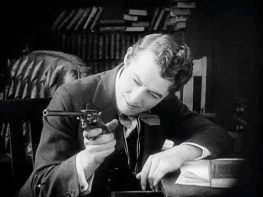 One of Walthall’s most dynamic scenes occurs when he chances upon his uncle sleeping, prone and helpless. Blood-rimmed eyes watering, his hounded, haggard expression suddenly takes on the lean, hungry look of a wolf as he listens to baying in the distance, his startling lycanthropic transformation worthy of Lon Chaney. Driven to the point of desperation, he looks genuinely insane as he slowly rises from his chair and creeps toward his victim. Ingeniously, the actor engenders suspense by deliberating over what weapon to use, imagining he’s tickling the ivories of an invisible piano along his desktop before the pistol from his drawer finds its way into his hands. Admiring its heft and shiny polish he playfully points it in his uncle’s direction, and is only prevented from pulling the trigger by unpleasant thoughts of dangling from the hangman’s noose. Gnawing at him, it’s this avenging conscience that does him in the same way he had his uncle. Having long feared concluding his career at the end of a rope, The Nephew winds up hanging himself before the law can even escort him to the gallows.
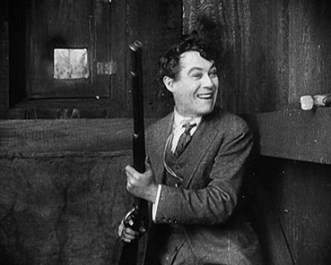 Alongside his other technical innovations, Griffith deserves credit for refining the art of screen acting. Moving the camera in closer allowed his performers to register thoughts with the slightest inflection, removing the infant medium a step further from the stage theatrics of playing to the back of the house. In its review of The Avenging Conscience, The New York Dramatic Mirror stated of the Griffith school of acting “There is none better.” However his feature films were invariably slanted to emphasize the performances of his female players, at the expense of his actors. As Marjorie Rosen points out in her Popcorn Venus, “the way his camera played on them gave them a universality that eluded his male characters.” The Avenging Conscience is almost unique among Griffith’s silent films in revolving exclusively around a strong male lead. Where Blanche Sweet, Walthall’s most frequent co-star at the time, had been given preeminence in their earlier Judith of Bethulia pairing, here the director diminishes her importance so that the actor’s impressive performance can assume center stage.
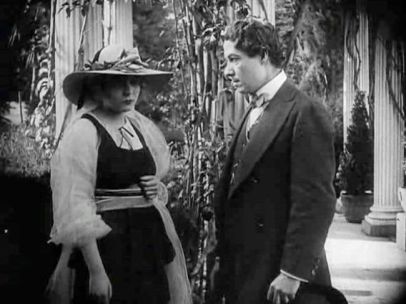
As he revealed in an August 1915 Photoplay interview, Walthall was a snooty stage actor when he arrived at Biograph intent on rescuing friend James Kirkwood from the disgrace of life in the movies. Instead he found himself unexpectedly thrust before the cameras as well. Entering films in 1909, the year Griffith made The Life of Edgar Allen Poe which is included as a supplementary feature on the Kino DVD release, Walthall left after a year to make scores of shorts for a variety of other studios before returning to the Griffith fold in 1912. He was among the stock company of actors who joined the exodus from Biograph, following the director out to California to make longer movies.
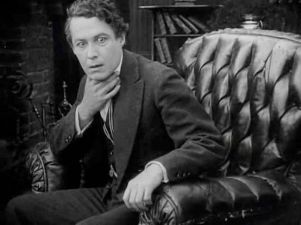 Walthall’s diminutive, wasting frame frequently led to him being cast as ardent artists and strolling troubadours, including John Howard Payne in Home Sweet Home, and made him a perfect fit for the consumptive Edgar Allen Poe stand-in here. In fact he showed such a strong affinity for the writer’s work in this film Seymour Stern once described as ‘an Edgar Allen Poe mosaic,’ that the part appears to have typed him for a bit. He more or less revived his vision-haunted, frustrated author for the following year’s Poe biography The Raven. Acclaimed as the ‘Edwin Booth of the Screen’, as Anthony Slide relates in his book The Idols of Silence, even before The Birth of a Nation was released Walthall had again accepted the lucrative offers of rival studios for his services. He’d return to Griffith a few years later to appear in The Great Love, but critics at the time found his performing style too florid. Like Earle Williams and the others who would’ve been up for the 1913-14 Best Actor Oscar, by the early ‘20s Walthall’s star was in eclipse.
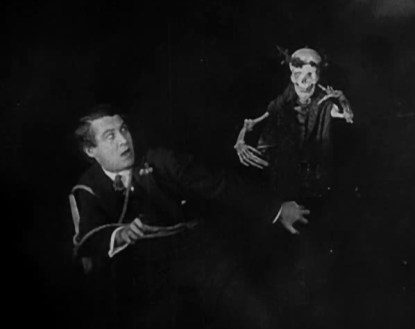
He reemerged in the late silent and early sound era however, in titles like The Scarlet Letter, Wings, Abraham Lincoln, The Cabin in the Cotton, Viva Villa!, Dante’s Inferno, Judge Priest, A Tale of Two Cities, among others, as a powerful character actor, managing to carve out a successful second career for himself. He could frequently be found in such Tod Browning cult classics as London after Midnight and The Devil-Doll, his past as a horror pioneer coming back to haunt him. Frank Capra was considering Walthall for the role of the High Lama in Lost Horizon when the actor died in 1936, three weeks after completing scenes for his final film. According to Kalton C. LaHue in Gentlemen to the Rescue, “Walthall’s years with Griffith were his greatest, despite the fact that he continued to give superior performances well into the thirties.” Having ascended to the summit at the very dawn of features makes Henry B. Walthall the man most worthy of my first Best Actor Oscar.


 CRAFT D MOVIE CRITIQUES