
BEST CHOICE:
Lillian Gish
 (Broken Blossoms)
EXTANT


BEST CHOICE:
(Broken Blossoms)

 Having left movies such a long and storied legacy spotted with superlative performances, it’s worth noting that Lillian Gish’s legendary reputation really began with her breakthrough role as Lucy Burrows, the abused waif of Broken Blossoms. Her earlier, emotionally charged performances for mentor D.W. Griffith, in such epics as The Birth of a Nation and Hearts of the World, had been widely admired. But typed by the director as a pure, poised, ice cool lady, she had been upstaged by the livelier turns of the secondary leads in those films. As the principle female star of Broken Blossoms however, there was nothing to distract from Gish’s emotionally wrenching work, which fully revealed the depths of her remarkable talent for the first time.
 So much so that her performance is still regarded as one of the most indelible in all silent cinema, and “one of the most praised of her career,” according to former George Eastman House archivist James Card in his book Seductive Cinema. Anthony Slide concurs in 50 Great American Silent Films 1912-1920, “If one were to select a single film to represent Lillian Gish’s career, there is no question it would have to be Broken Blossoms… one of the greatest emotional roles ever captured on celluloid… (it’s) never been duplicated by screen actresses before or since.” Just as celebrated in its own day, Gish would, I’m certain, have been thrown her first bouquet as the year’s Best Actress.
 With Broken Blossoms, it was felt she had fully emerged as one of cinema’s great artistes, her name beginning to be bandied about in the same breath as Bernhardt, Duse, and the other revered theatrical luminaries of the period. As “James Agate, re-seeing (the film) some years later, wrote… Gish’s performance ‘still seems to me surpassingly true and moving. She puts into her scenes of terror as much pathos as Sarah (Bernhardt) ever put into Tosca… I do not say that this little girl is as great an actress as Sarah… What I do know is that in this one picture she ranks with the world’s great artists.” (The Great Movie Stars: The Golden Years by David Shipman).
 Frequently beaten by her father, a professional boxer named Battling Burrows (Donald Crisp), one night Gish’s Lucy collapses in the curiosity shop of a Chinese man, Cheng Huan (Richard Barthelmess), who had often admired her from afar. Over the course of several days, as he nurses her back to health, Lucy learns for the first time what it is like to be treated kindly, blossoming under Huan’s tender ministrations. Hearing where his daughter is, Battling hunts her down and drags her home. Attempting to escape her father’s wrath, Lucy locks herself in a closet to hide. Chopping down the door, Battling drags her out and beats her to death.
 Of the many persecuted innocents Lillian Gish portrayed for Griffith, little Lucy Burrows was her most pitiable. Conceived in a spirit of pure pathos, touched off by an ethereal spark of genius wholly unique to the actress, Gish appears to have been influenced in equal parts by Mary Pickford’s unfortunate Cockney slavey, from the previous year’s Stella Maris, and, oddly enough, Charlie Chaplin’s Little Tramp. Not coincidentally, inspiration for Chaplin’s beloved character had grown out of the comedian’s own poverty-stricken, Dickensian childhood in a turn-of-the-century London markedly similar to the one depicted in Broken Blossoms.
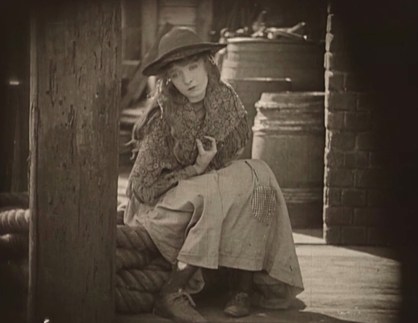
 Despite her own bedraggled personal state, Gish’s Lucy makes touching efforts to put on the same sort of genteel airs affected by Chaplin’s own Tramp. Daintily picking over the modest treasure inherited from her mother (“Dearie, This ain’t much but all I got to leave you…”) with all the fluttering movements of a magpie, she gussies up her appearance before going out by tying a lone silk ribbon in her hair.
 Looking as if her half-starved, shivering body were still doubled over from one of Battling’s blows, Lucy’s bowed back might be the result of broken bones never fully healed, as she’ll suggest when she fearfully starts clutching at her still lame arm when her father pulls out the bullwhip. As Neil Sinyard points out in his Silent Movies, her “growth seems stunted by her domestic prison.” Using similar mincing steps to those the Chinese man had earlier, as though his feet had been bound from birth, she walks gingerly, with undue deliberation. Not wishing to subject her “… bruised little body …” to further torment, she long ago learned to tiptoe on eggshells around her tormentor, for fear that the slightest provocation might set him off.
 Gish’s semblance of a sickly demeanor was not all acting, since the actress contracted Spanish flu soon after rehearsals began for the movie, with Griffith insisting, according to Kevin Brownlow in Behind the Mask of Innocence “that (she) wear a (surgical) face mask whenever possible.” She was so weak and miserable during filming that the classic gesture, where her character unhappily simulates the contours of a smile by pushing up the corners of her mouth, was improvised on the spot. Determined to turn her frown upside down and soldier on, this inspired bit, one of the hallmark moments of Gish’s career, so impressed Griffith that he went back and sprinkled it throughout the entire film as a recurring motif. This effort to put on a happy face would became an iconic silent touchstone, one so enduring that Chaplin himself
  may have been equally inspired by Gish, when he employed it at the end of his final silent film Modern Times, threading the sentiment into his classic musical motif ‘Smile.’ With silent performers having little beyond their facial features to convey what they were feeling in close-up, Gish offers a vivid demonstration of eloquent acting by intimating to us Lucy’s internal emotions, which are belied by the flickering, false smile on her face. Our only insight into what she is actually feeling is through her wide, fearful eyes. And the eerie, disconcerting quality Gish affects here anticipates Conrad Veidt’s macabre Man Who Laughs, whose mouth was likewise frozen into a permanent rictal grin, more resembling a grimace. Gish’s smile seems just as eerily out of consort with the rest of her
  face, remaining fixed, even while her entreating eyes are welling up with tears, then with terror. Lucy’s obedient acquiescence to “Put a smile on yer face” whenever her bullying father orders her to, possesses additional resonance for modern viewers. From the earliest age, girls are told they would look prettier if they smiled, reinforcing societal expectations that women must be pleasing and socially agreeable, disregarding what they may actually be feeling inside (“Poor Lucy, never having cause to smile, uses this pitiful excuse instead.”). The thinly veiled societal insistence that women need grin and bear it, has today become a byword for casual sexism.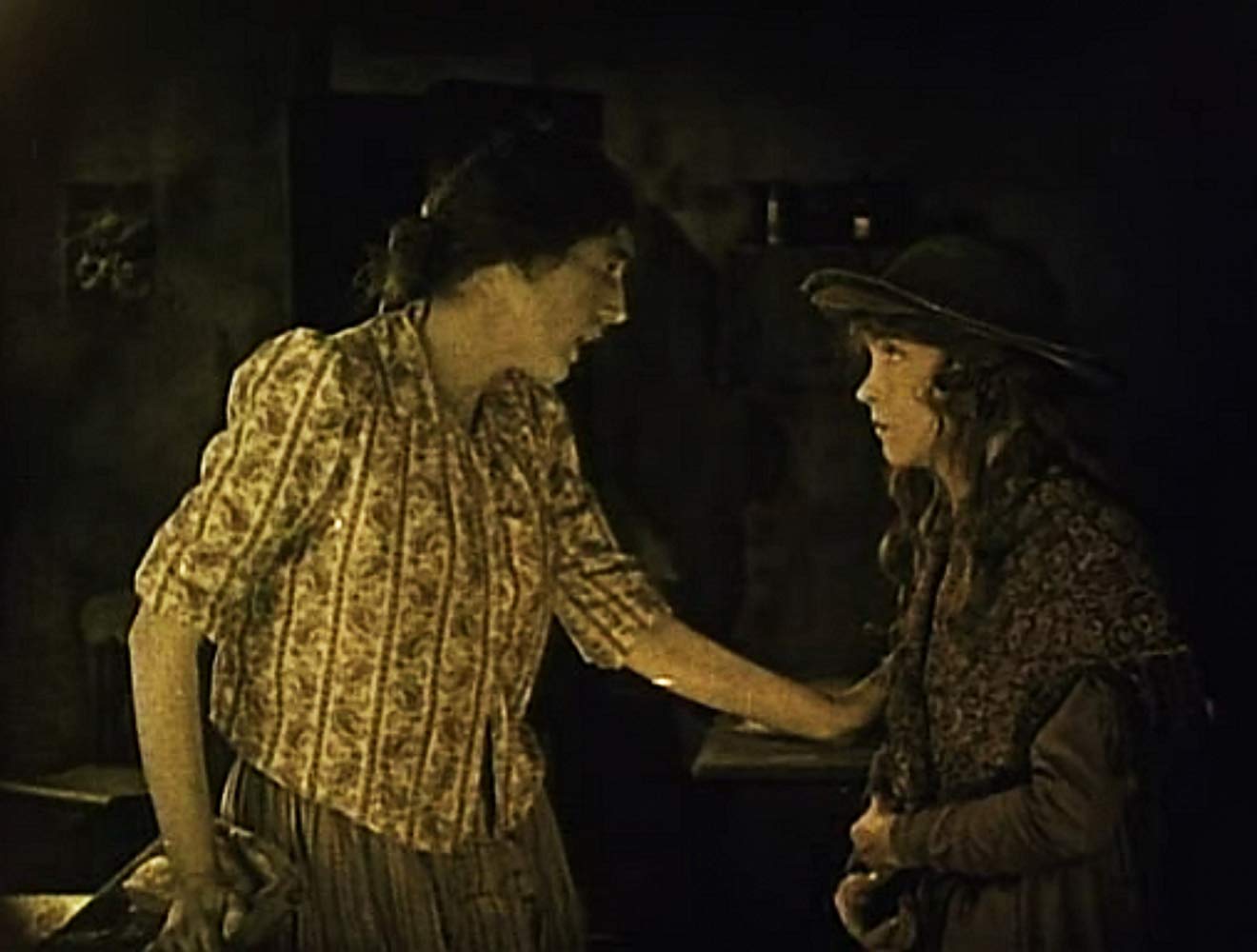
 Lucy subsists in a state of virtual slavery, cooking and cleaning for her abusive father who she must wait on hand and foot. Courteous men rise when a lady enters the room, but it’s Lucy who is forced to stand in attendance, pitcher of beer in hand while Burrows wolfs down the meal she’s prepared, only to be knocked about if she makes the slightest misstep. Her boxer father uses any pretext to bat his daughter about for sport, as if he were training in a gym, placing her in the unenviable position of “…serving as (his) punching bag…” Caged with this pacing tiger, Lucy feels as hemmed in by the four walls as if they were the corners of a boxing ring. And when Battling does violently pounce, over some imagined or invented slight, chasing her around the table, she foreshadows the same circular motions she’ll later make when cornered by him in that small closet.
 Where Battling Burrows is brutish and cruel, Huan takes Lucy in and cares for her, cleaning and neatly dressing her wounds, proving loving and tender in a way Lucy never knew a man could be, renewing her faith in the sex. Experiencing “The first gentleness she has ever known,” she’s treated with great deference, wanting for nothing. Abused and uncared for all her life, she’s now placed on a pedestal to be cherished, worshipped and adored, with even her “…room prepared as if for a princess.” Fussing and fawning over her every comfort, Huan even replaces her hair ribbon with an orange blossom wreath, a crown fit for royalty.
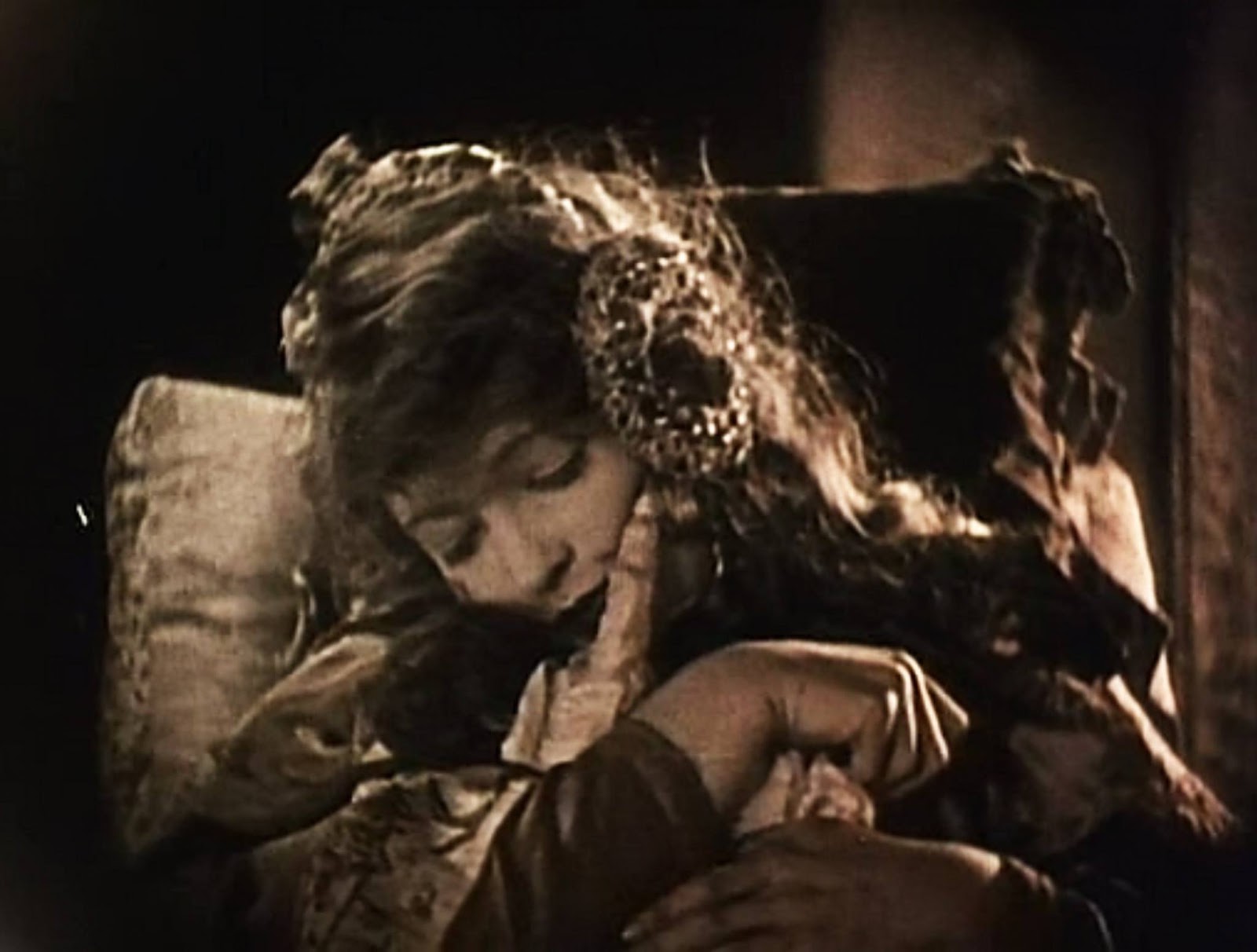 porcelain figures, stepped out of the collection and come to living, breathing life. All dolled up, she can hardly believe it’s her own reflection staring back in that mirror with such redolent beauty (“… her beauty so long hidden shines out like a poem”). Happy for the first time, her mouth reflexively begins to edge up into a spontaneous smile of its own accord, without any assistance on her behalf. Or, as silent film historian Edward Wagenknecht put it in The Films of D.W. Griffith, she “smiles naturally, and this time with her eyes as well as her lips.” Under Huan’s care, Lucy ‘blossoms,’ unfolding her splendors before him like a petal after a fresh, warm rain. Picked out of the gutter, watered, and tended, this badly bruised little blossom ornaments and beautifies the sad Chinaman’s spare, empty life, same as Lucy earlier tried to purchase that flower arrangement
  in the vegetable seller’s window, to brighten her own drab existence. Due to a carefully cultivated persona of spiritual serenity and artistic purity, Gish was often associated with the sort of ungilded lilies she frequently found herself photographed with in studio stills. So, it’s no surprise that Griffith, like Huan, would also want to link her Lucy with flowers here. The Chinese robe she wears is adorned with cherry blossoms, while she’s given flower-scented perfume in a bottle imprinted with petal shapes. In accord with all this floral imagery, the titles themselves draw a direct analogy with her blooming beauty, bestowing upon “… this alabaster cockney girl her love name – White Blossom,” a musical motif Griffith composed specifically for the character.
 Gish has always been regarded more as an austere artist than one of the glamourous beauties of the screen, but she’s absolutely breathtaking in Broken Blossoms. It may have been Huan making her Lucy over onscreen into the realization of his dream vision, but it was director Griffith who gave her the full-blown Hollywood treatment for this role. According to David A. Cook in A History of Narrative Film, he permitted Gish’s personal photographer and cameraman, Hendrik Sartov, to be “brought into the production at her insistence,” in order to render her with innovative, romantic lighting and portraiture techniques, that transformed the actress, bringing out all of her most flattering highlights. Given how lovingly she’s photographed here, Gish proved herself the full equal of any of the manufactured fashion plates rolling off the dream factory’s assembly line.
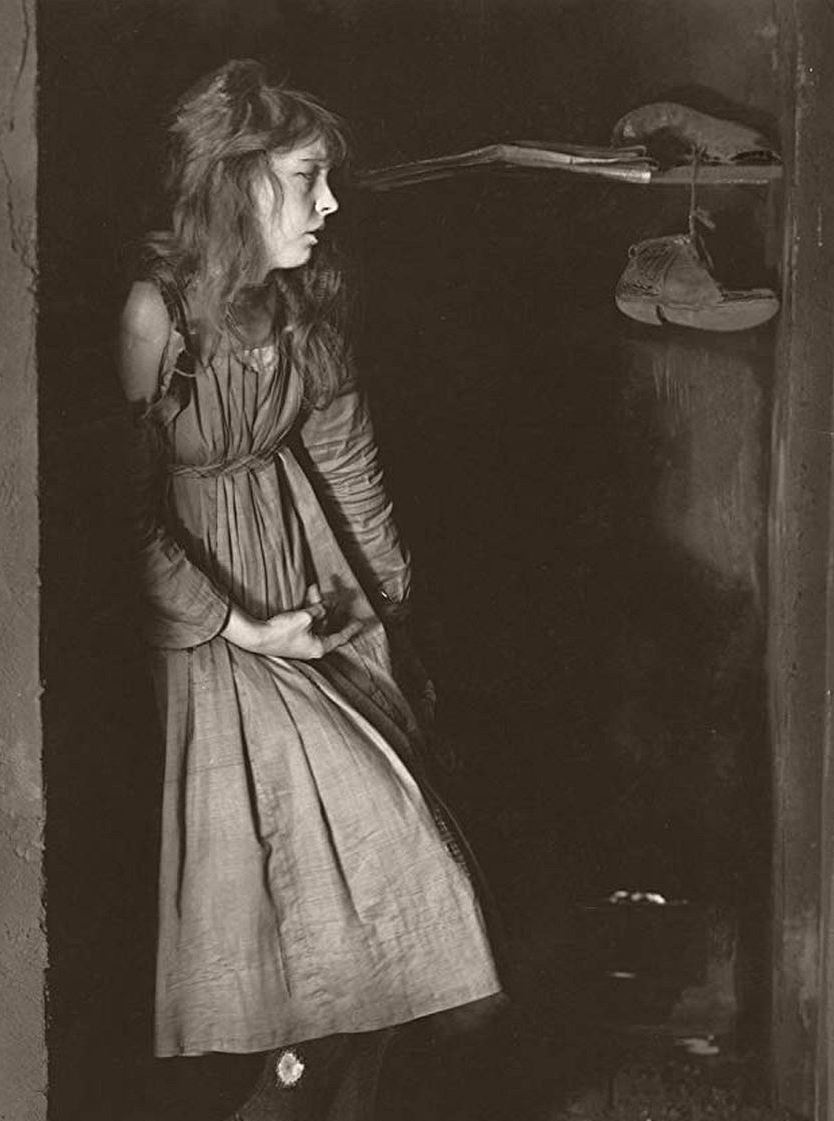
 This is the moment where both the film and Gish’s performance reach their dramatic heights. In a filmed interview, the actress compared her approach to this scene as being similar to that of a wild animal, since a trapped child would likewise react in a feral manner, as her Lucy does when cornered. Having run into the closet seeking shelter from the father storming around outside with an axe, she spins wildly about, clawing at the wood and practically climbing the walls. As it gradually dawns that there’s no escape for her, she’ll scream, begin to slip into a faint, then come to with a start before realizing she’s still trapped in her living nightmare, and begin shrieking all over again. Cowering in a corner as she awaits her awful fate, she’s unwittingly entombed herself in this recess which will become her coffin.
 One of Gish’s most harrowing moments on film, her acting is so intense there’s little wonder the pitch of hysteria she hit shook everyone during filming, even making a visiting Variety reporter violently ill. By the early ‘20s, the scene had already become legend. Quoting Frederick James Smith, in the May 1923 issue of Photoplay, “When the Broken Blossoms scene in the closet – still the screen’s highest example of emotional hysteria – was shot in Los Angeles, the screams of Miss Gish, alternating with the cries of Griffith, could be heard in the streets outside. It required most of the studio staff to keep the curious from trying to invade the studio.” According to anecdote, Gish took the startled set by complete surprise, by throwing everything she had into the scene. But interestingly, years later, co-star “Barthelmess report(ed) that her hysteria was induced by Griffith’s taunting of her… (Yet) no matter how it was achieved, the result is memorable, one of the privileged moments of Gish’s career.”
 As Sinyard states in Silent Movies, “Lillian Gish gave what is assuredly one of the most memorable performances of the silent era. Her hysteria in the closet as she tries to hide from her murderous father was a cameo of naked fear that terrified contemporary audiences.” Orphans of the Storm co-star “Rudolph Schildkraut called it the finest acting he had ever seen.” (The Films of D.W. Griffith). And in the opinion of Richard Schickel in D.W. Griffith: An American Life, “Lillian Gish’s remarkable performance… is what, in the final analysis, makes (the movie) unforgettable.” “This time… there was to be no reprieve for Miss Gish,” no last-minute rescue, as sadly, her Lucy becomes the poor “blossom of innocence broken and trampled by male brutality” left as limp and lifeless as her little China doll.
 Bursting into brilliance like a morning glory, Gish fully blossomed playing Lucy Burrows, “easily the high point of her career,” according to Wagenknecht. So perhaps unsurprisingly, as David Shipman notes in The Great Movie Stars: The Golden Years, this role would prove the actress’ “own favourite among the Griffith films.” Watching her bud, bloom, wilt, and fade like a transitory rose during her character’s brief and fleeting time on this earth, contemporary filmgoers bore mute witness to the flowering of one of silent cinema’s greatest stars. According to Kalton C. Lahue in Ladies in Distress, after this performance, Gish “had no peers on the screen.” Presaging an extraordinary career, Broken Blossoms opened the door to a procession of other bravura performances, with which the actress would continue enriching movies over the course of the evolving century.

 CRAFT D MOVIE CRITIQUES