


BEST CHOICE:

BEST CHOICE:

 of the
  Rex Ingram’s lush, stylish epic The Four Horsemen of the Apocalypse rode roughshod over the year’s competition when it galloped into movie theaters in 1920-21, dwarfing in size and scope nearly all other native offerings. Concerning the Franco-Prussian branches of an Argentinean family who find themselves on opposing sides during WWI and the prodigal son spiritually redeemed by serving his country, it captured the shattered idealism wrought by the recent conflict, bringing it all home to the cynical, disenchanted Lost Generation and becoming one of the biggest box office hits of its era.

 Cooper’s storied leather stocking tale. Jointly directed by the silent screen’s great visual stylist Maurice Tourneur and assistant Clarence Brown, it managed to match The Four Horsemen’s cinematography shot for glorious shot. In addition to its soaring imagery, The Last of the Mohicans unfolds its brisk tale with the stately, elegiac grandeur of a terse, tone poem. Though their picturesque qualities run neck and neck in a race too close to call, I’d still rank the Tourneur film a shade over The Four Horsemen. In fact, I’d place The Last of the Mohicans in a class by itself, and I’m not alone in estimating it so highly. In his indispensable history of American Silent Film, William K. Everson rated it a masterpiece.

 The pair is tracked to a mountain ledge where Cora has kept her captor at bay by threatening to jump if he approaches. Momentarily nodding off, she’s seized by Magua who retains a tight grip despite Cora’s attempt to make good her threat. Seeing Uncas approaching in the distance, she tries to scramble back up the rock face only to have Magua, who has spied his enemy as well, pry her fingers loose causing Cora to fall to her death. In the ensuing struggle, Uncas is also killed and the fleeing Magua brought down by a musket shot from Uncas’ father, Chief Great Serpent (Theodore Lorch) and Hawkeye (Harry Lorraine), a white man who has thrown in his lot with the Indians. The dying Uncas’ final gesture is to tenderly take Cora’s limp hand. His body is placed on a wooden spirit tower, where his father stands sad sentinel, mourning the passing of the last of the Mohicans.

 compositional balance, stylized design, the flow of lines and contours, tonal gradation, shading, lighting and the temperature of colors (his films must be viewed tinted and toned). Seen today, his directorial style makes sense of such piquant terms as ‘painting with light.’ Possessing a visual elegance apparent even to the casual observer, Tourneur’s films are among that rarefied breed capable of invoking an aesthetic response in the viewer. His unerring artistic eye renders each masterfully framed shot so stunningly, they can be heartbreaking in their flawless beauty. One responds emotionally to such evocative, atmospheric images as that of a tattered English soldier arriving half dead at command headquarters to announce the advance of Montcalm’s forces, or three garrison troopers lined up hillside at daybreak, drumming roll call as the British flag is hoisted in time to the rising sun.
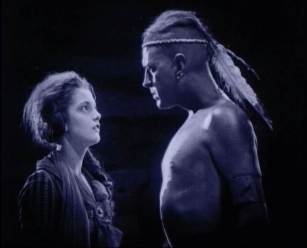 forever on the Mohican people. The groupings inside the cave itself position characters in a manner meant to take optimum advantage of chiaroscuro lighting, making the Huron shadows cast on the rock walls as they comb every crag and crevice seem even more menacing. When Magua’s shadowy hand creeps over Cora’s prostrate form later, its ominous, distended features could have been envisioned by F.W. Murnau for his Nosferatu the following year. Lush, location photography with Big Bear standing in convincingly for the Hudson River Valley, boasts gorgeous scenery and superb vistas, including scenes of war canoes skimming across the shimmering, still surface of the lake. The camerawork of Philip Dubois and Charles van Enger might have been based on Romanticist painting. It’s so ravishing that the picture at times resembles a landscape watercolor come to life. Watching a Tourneur film like this goes beyond moving pictures; it’s like viewing the moving canvas of some old master.
 nder his wing a promising young protégé in Clarence Brown who served as assistant director on nearly all Tourneur’s films from 1915 onward. When Tourneur was laid up by an accident during production on The Last of the Mohicans, Brown took over directorial duties for the duration. Adhering to detailed shooting instructions, the apprentice proved to have studied his mentor’s methods so meticulously, the end result proved indistinguishable from the Tourneur house style. Consequently it’s difficult to ascertain who deserves principal credit for the film’s outstanding quality. While assistant Brown was responsible for shooting the majority of the movie, the atmospheric look, feel and mood are so in keeping with Tourneur’s temperament one can’t see where the teacher left off and his student began. Conceived and shaped by Tourneur’s guiding vision, The Last of the Mohicans seems an unmistakable auteur piece from start to finish, despite the generous assist from other hands.
 subservient to the story for once. The movie’s three major action set pieces – the ambush at the cave which briefly subsides before concluding at the block house, the Fort William Henry massacre and the climactic cliff peak standoff – have all been expertly staged and choreographed. One never forgets such suspenseful scenes as the hand-to-hand knife fight between Magua and Great Serpent which begins with the two circling each other, weapons at the ready, the camera panning around them before each runs directly toward the lens. The astonishingly put together Fort William Henry massacre is truly bloodcurdling, treating viewers to such hair-raising sights as a wild eyed Huron crawling into the shade of an overturned wagon where a young mother has huddled for safety. Creeping closer and closer toward the camera and into a luridly graphic close up, when he hurls her baby into the air the unexpected act is as startling in its savagery as that scene where an infant was
  tossed out the window in The Heart of Humanity. Brown used a perambulator for the bravura tracking shot where he follows alongside Cora’s terrified little group as they attempt to pick their way through the carnage without attracting notice. Our attention, like theirs, has been so distracted by the violence swirling all about them we’re as startled as they are when the camera comes to a screeching halt before the startling figure of Magua suddenly blocking their path. While there’s much in The Last of the Mohicans that was clearly inspired by D.W. Griffith, the great director would return the compliment in kind. The Indian massacre which climaxed his historic epic America, with bodies piling up outside the barracks, was staged in flattering imitation of the Fort William Henry massacre here. And it’s to The Last of the Mohicans’ credit that the Griffith sequence seems no better mounted nor tautly sustained.


 here goes further than Griffith had dared. This is no spiritually chaste, one-sided affair from afar but rather a fully reciprocated, earthy physical attraction, with the white woman shown to be as drawn to the Native American as he is to her. There’s no mistaking their mutual interest, which may be a portrayal totally unique in all of silent cinema. Cora’s attraction to Uncas immediately serves to set her apart from other silent movie heroines and Barbara Bedford, an almond-eyed, darkly somber beauty, fashions a fascinatingly offbeat, complicated characterization that critic Andrew Sarris described in his book The American Cinema as “expressively perverse,” cutting clear across the years. In an era of virgins and vamps, her Cora seems startlingly forward and direct in her emotions. Possessed of a matured woman’s longings and desires, she doesn’t play her attraction to Uncas innocently, but rather knows what she wants and is very daring in making her feelings apparent.
 I think Bedford’s best moment is when Cora sings Uncas’ praises as he stands stoically in a blanket with his back to camera after reuniting her with her father. Excitedly gushing about his heroic deeds, she unwittingly makes her feelings toward him so obvious that her father gives her a searching look, causing her to remember herself and blush at her impropriety. Cora even admits Uncas into her bedroom at night for a clandestine rendezvous, something no properly brought up young lady would ever do. Her eyes glazed by the tedium, to Cora Uncas represents freedom from her staid, conformist existence. When Randolph stifles a yawn during the minuet, nervously darting his eyes about the room to ensure no one has seen him, the hint of a smile playing across Cora’s lips makes it obvious she sympathizes with fellow feeling, being just as bored by the social conventions. Still waters run deep
 and beneath the deceptive surface, this woman who politely plays the harp like an angel secretly yearns for blood and thunder. Where a title states that “Even in a wilderness, gently bred women somehow maintain the grace and dignity of life,” we realize that to Cora this belies the purpose of coming to such a place to begin with. Like a heroine in a bodice-ripping romance novel, she longs for adventure, the liberating abandon embodied by the untamed Indian freeing her from the constraints of polite society. This is why her attention is immediately arrested by the appearance of Uncus, who gives her a glimpse at a life she never expected to experience firsthand. Tellingly, when Cora first claps eyes on him, he does not enter the fort but instead stands framed in the doorway, an intermediary figure in this transitional place, situated between the indoors and outside, the civilized and the savage.
 bringing her to full, responsive life for the first time. Ambushed in the forest, she’s exhilarated to take part in the action, loading muskets until the powder horn runs empty, proving herself useful during battle by resourcefully ripping her traveling scarf to patch the lead balls. Randolph scolds Cora, “the daughter of Col. Monroe! – Admiring a filthy savage,” but her withering look of disapproval tells us what she thinks of his superior attitude. He may be aghast that she could find anything to admire in such a native son, but the movie breaks novel ground in presenting the upstanding Indian as the hero of the piece, instead of the pale face. The Uncas of actor Albert Roscoe, who had been Theda Bara’s leading man, puts things in “The simple words of a savage…” as stated in the simple words of this silent, but The Last of the Mohicans reveals depths of sympathy and understanding for marginalized others rare for films of that era. All the representative whites are, to a man, depicted as less chivalrous,
  dependable, trustworthy, heroic, brave and virile than this ‘noble savage.’ Colonel Monroe respectfully shakes Uncas’ hand after he rescues his daughters while Montcalm and his military brass scornfully turn their backs on Randolph’s Benedict Arnold, after he proves a turncoat to the flag he serves. Both Randolph and the psalm singing preacher desert the women in a crisis rather than defending their honor. Uncas, on the other hand gallantly treks across the unmapped wastes of America’s lush northern frontier in his odyssey to rescue Cora. Even the otherwise stalwart Maj. Heyward consistently requires his rescue, first when a Huron gets the better of him on a boulder at the cave then from the chopping block at the stockade. And unlike the indignant Uncas, Heyward is more than willing to let Cora become Magua’s squaw if it will save his own Alice from such a fate. The real villain of the piece however is Magua, and much pain has been
  taken to draw a clear line of demarcation between the ‘good’ and ‘bad’ Indian. Knowing the besieged party is out of ammunition for instance, Uncas wastes his last shot in a mercy killing, putting a wounded enemy out of his misery. The pitiless Magua on the other hand subsequently states, “I don’t kill my prisoners. I torture them.” Though his starring days were still far in the future, Wallace Beery steals the show as the heavy. Magua gives him an early opportunity to portray the sort of gruff, vulgar, slovenly, uncouth character, both dangerously volatile and slightly oafish, for which he’d win wide admiration in the coming years. By the end of the decade his bulging filmography would include other notable appearances in Behind the Door, The Virgin of Stamboul, Robin Hood, The Spanish Dancer, The Sea Hawk, The Lost World, The Pony Express, Old Ironsides, Beggars of Life, among others. He was even in The Four Horsemen of the Apocalypse.
 forcing Cora to become his squaw to save Alice. It’s only with his elimination that Cora and Uncas can be united and lasting peace established. After seeking to pry them apart the entire film long by claiming Cora for himself, it’s simple irony that it should be Magua to unite the lovers in death, ensuring both eternal bliss in the happy hunting grounds. Tourneur has turned Cooper’s buckskin epic of the colonial frontier into a romantic tragedy worthy of Shakespeare. Like Romeo and Juliet, Cora and Uncus are martyr figures whose deaths inspire a cessation of hostilities between their warring factions. Their sacrifice serves to blood the keel, consecrating the democratic principles upon which the forthcoming country will be founded, wherein all races, classes, creeds must find a way of getting along together in order to peaceably coexist.

 I have seen the passing of the last of the Mohicans.” Regrettably, the real reason why the once mighty Mohican nation has been reduced to the verge of extinction is evaded in the film. By sublimating all villainy into the character of Magua, who kills off the sole surviving descendant, whites are effectively whitewashed of culpability in the decimation of America’s indigenous population through disease, spirits and the policies of manifest destiny. While the tragic theme is undermined by the film’s refusal to point any accusatory fingers, when Hawkeye, the one white man who fully grasps the enormity of what has transpired, offers Great Serpent his hand at the end it’s in collective apology for the historic sins of his people. Even without making an overtly political statement, as social commentary the movie is as daring as The Vanishing American in its implied criticism.
 film concern, a more auspicious legacy couldn’t have been left to posterity. With virtually every delicate, finely shaded, lovingly detailed shot suitable for framing in a gallery, if ever there was a work of art crying out for conservation this is it. Excerpting critic Burns Mantle’s vintage review of the film in Photoplay, George Eastman House curator James Card quoted in his book Seductive Cinema, “If we had a National Cinematographic library, as we should have, into the archives of which each year were placed the best pictures and finest examples of the cinematographic art achieved during the year… I certainly should include The Last of the Mohicans.” Over seventy years later Mantle would get his wish. In 1995, The Last of the Mohicans was officially inducted into the National Film Registry by the Library of Congress.

 CRAFT D MOVIE CRITIQUES